
Your stairs get walked on more per square foot than any other floor in the house, and every step lands on the same narrow strip of carpet at the front edge. That is why stair carpet looks tired years before the hallway it connects to.
Choosing carpet for stairs works differently than choosing it for a bedroom. Footing, edge wear, and how the carpet is wrapped matter more than softness or color.
The Part of the Stair That Fails First
Look at any worn staircase and the damage is in the same place: the nose, the rounded front edge of each tread.
Your foot lands there, pivots, and pushes off. The carpet is stretched tightly over a curve at that exact point, so the fibers are already under tension and spread slightly apart before anyone steps on them. Traffic that would take a decade to show on flat floor shows up on a stair nose in two or three years.
Everything that follows comes back to protecting that edge.
Pile Height and Density Do the Heavy Lifting
Go low and dense. That single sentence covers most of what makes stair carpet last.
A short pile keeps the fibers upright and supported. Tall pile bends further under load and has more length to fold over, which is why plush and shaggy styles look crushed on a stair nose so quickly. Anything with real length also makes footing feel soft and uncertain on the way down.
Density is what actually stops the wear. Densely packed tufts brace each other and spread the load. Loosely packed tufts fold individually, and once they lie flat on the nose, the backing starts taking the abrasion directly.
You can test density on a sample in about five seconds. Bend it backward with the pile facing out, the way it will curve over a stair nose. If the backing shows through easily between the tufts, that is exactly what will happen on every step in your house. A dense sample stays packed even when you bend it.
Also check the twist, meaning how tightly each yarn is twisted and heat-set. Tight twist keeps the tuft tips closed. Loose twist lets them bloom open and fray, which on a stair nose turns into visible fuzz along the edge.
Is Berber a Good Idea on Stairs?
Berber comes up constantly for stairs because it looks clean and wears well on flat floors. On stairs the answer depends entirely on the size of the loop.
Large-loop berber is a poor choice for stairs. Stretched over the nose, those big loops open up and become easy to catch. A dog's claw, a heel, or a vacuum can pull one. Because the loops are continuous yarn, a single snag can run along the row like a pulled thread in a sweater, and repairing that on a stair is difficult and rarely invisible.
A tight, small-scale loop is a different product and performs well. Low-profile level loop with small, dense loops resists crushing beautifully and does not open up the same way over the curve.
If you have pets with claws, a cut pile removes the snagging risk entirely and is usually the safer decision.
Which Fibers Belong on Stairs
Nylon is the benchmark for stairs. Its recovery is the best of the common fibers, which is precisely what a stair nose needs after thousands of footfalls.
Triexta performs well too and brings stain resistance built into the fiber rather than applied as a coating. On stairs, where spills happen and cleaning is awkward, that has real value.
Polyester is a harder sell on stairs. It is soft and takes color beautifully, but it crushes sooner than nylon or triexta, and stairs are the worst possible place for a fiber that crushes. If you do choose it, choose a dense construction and accept a shorter life.
Wool is excellent on stairs, with natural resilience and soil-hiding that few synthetics match. It costs considerably more and needs the right care.
Our guide to triexta carpet covers the fiber in more depth, and you can compare constructions in our carpet collection.
Padding on Stairs: Firmer and Thinner
The padding decision for stairs runs opposite to what most people assume. Thicker and softer is worse.
Thick pad on a stair is a safety problem. It compresses under your foot, so the tread feels like it moves as you step. It also makes the carpet harder to hold tightly over the nose, which loosens the very edge you were trying to protect.
Stairs need a firm, dense pad in a modest thickness. Density is the number to ask about, not softness, and a firmer pad in the 7 to 8 pound range or above is a reasonable target. Your installer can tell you what your specific carpet requires, since manufacturers set their own rules and the wrong pad can affect your warranty.
Our article on flooring underlayment explains why the layer you never see does so much work.
Waterfall or Upholstered? The Installation Choice Nobody Mentions
Carpet gets wrapped around a stair in one of two ways, and the finished look is noticeably different.
Waterfall
The carpet runs over the nose and falls straight down to meet the next tread, without being pulled into the corner underneath. It is faster to install and costs less. The look is soft and slightly rounded, and on a straight staircase it works well.
Upholstered
The carpet is pulled tight around the nose and pushed into the crease where the tread meets the riser, so it follows the shape of the stair exactly. Every step is defined and the result looks tailored. It takes longer and costs more.
Upholstered is the better choice in two situations. On curved or pie-shaped stairs, waterfall installation cannot follow the geometry cleanly. And with any patterned carpet, upholstered keeps the pattern aligned on every tread rather than letting it drift.
Ask which method your quote includes. It is a real difference in labor and in the finished look, and it is worth deciding on purpose rather than discovering afterward.
Runners: Getting the Reveal Right
A runner leaves wood showing on both sides of the stair, which is the reason to choose one when the treads underneath are worth seeing.
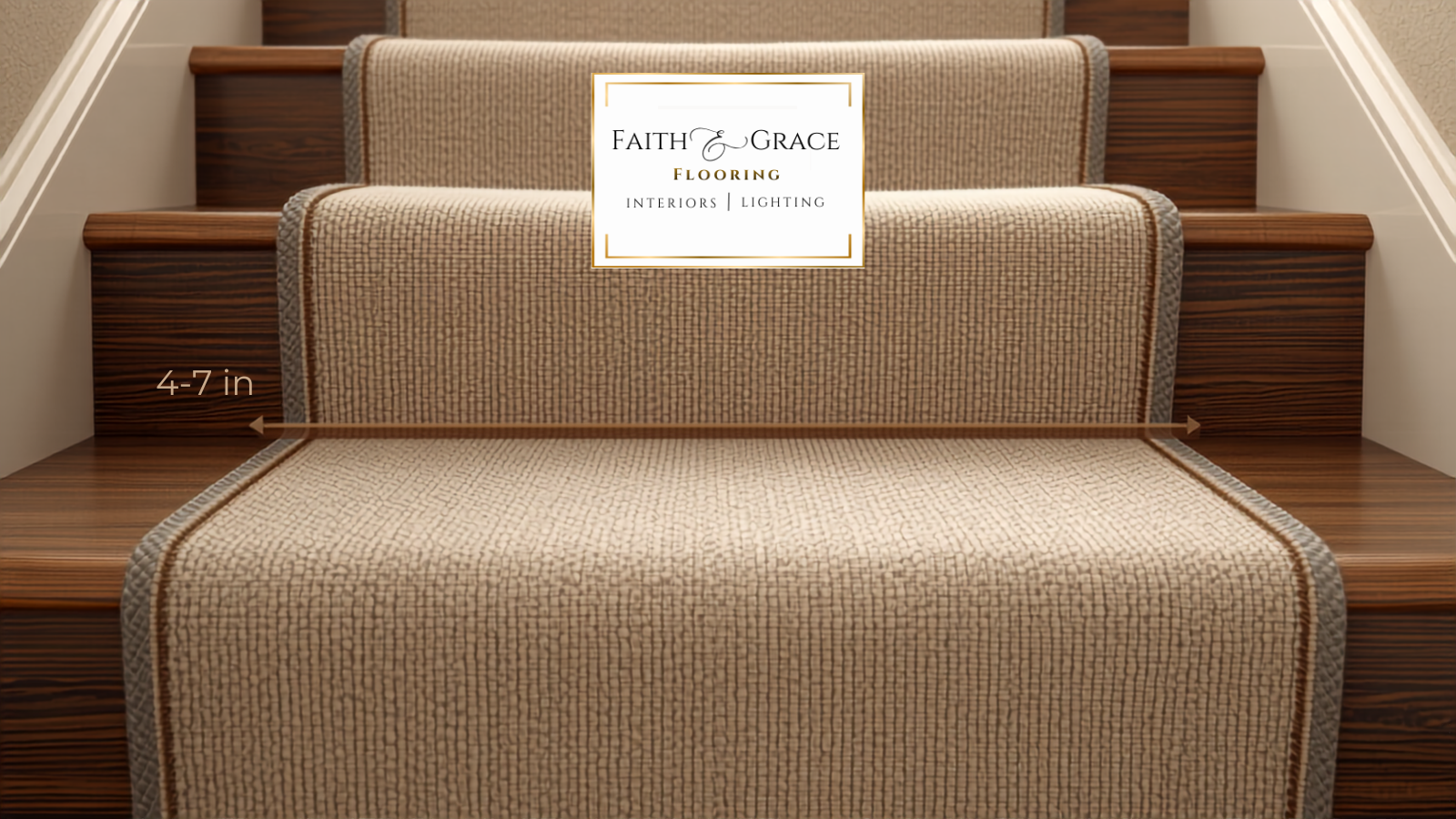
The width is the decision that makes or breaks it. Aim for an even reveal of about four to seven inches of wood on each side, depending on how wide your staircase is. Narrower than four inches and the wood reads as an accident. Much wider and the runner starts to look undersized for the stair.
Center it precisely. An off-center runner is the first thing a visitor notices, and on stairs there is no furniture to disguise it.
A runner needs the same secure installation as full carpet. Loose runners held down by nothing but their own weight are a genuine fall risk. Stair rods can be part of the look, but they are decorative on a properly installed runner rather than what holds it in place.
Because runners often need an exact width, they are frequently made by cutting broadloom carpet to size and finishing the edges. We do that work as custom stair runners, and the same binding and serging techniques give you a clean, durable edge.
Safety Details Worth Asking For
Stairs are where flooring choices stop being purely cosmetic.
Visible edges. Being able to see where each step ends helps everyone, and it matters a great deal for older eyes. Busy patterns with high contrast can visually flatten a staircase and hide the edge of each tread. A quieter pattern, or a color that contrasts with the wall and trim, keeps the steps readable.
Firm footing. Low, dense pile with firm padding gives your foot something solid. Deep, soft pile does the opposite.
Tight installation everywhere. Carpet that is not fully secured at the nose can shift under a foot. This is the single strongest argument for professional installation on stairs specifically, and our page on flooring services covers what our installation includes.
Watch the landings. A landing where carpet meets a hard floor needs a properly finished transition. A lifted edge at the top of a staircase is one of the most dangerous things in a house.
Getting More Life Out of What You Install
Vacuum stairs more often than you think you need to. Grit works its way to the base of the pile and cuts the fibers from below, and the stair nose collects it faster than anywhere else. A handheld vacuum kept nearby makes this realistic.
If your stair carpet still looks reasonable but the traffic path has gone flat, our guide to matted carpet and how to revive it covers what can be recovered and what cannot.
When the nose has worn through to the backing, replacement is the only real answer. At that point the fibers are gone, not flattened.
What to Bring to Our Murfreesboro or Nolensville Showroom
Bring the width of your stairs, the number of treads, and a note of whether any of them curve. Those three things determine most of the quote.
Then bend every sample backward over your fingers, the way it will bend over your stair nose, and look at how much backing shows. That one test tells you more about how the carpet will age on your stairs than the price tag does.
Faith and Grace Flooring installs stair carpet and custom runners throughout Murfreesboro, Nolensville, and the surrounding Rutherford and Williamson County communities. Bring your measurements to 902 Dashiel St in Murfreesboro or 7305 Nolensville Rd in Nolensville, see finished staircases in our project gallery, or read our customer reviews.
For a measured quote on your staircase, request a free in-home estimate and we will count the treads and price the installation method with you.