

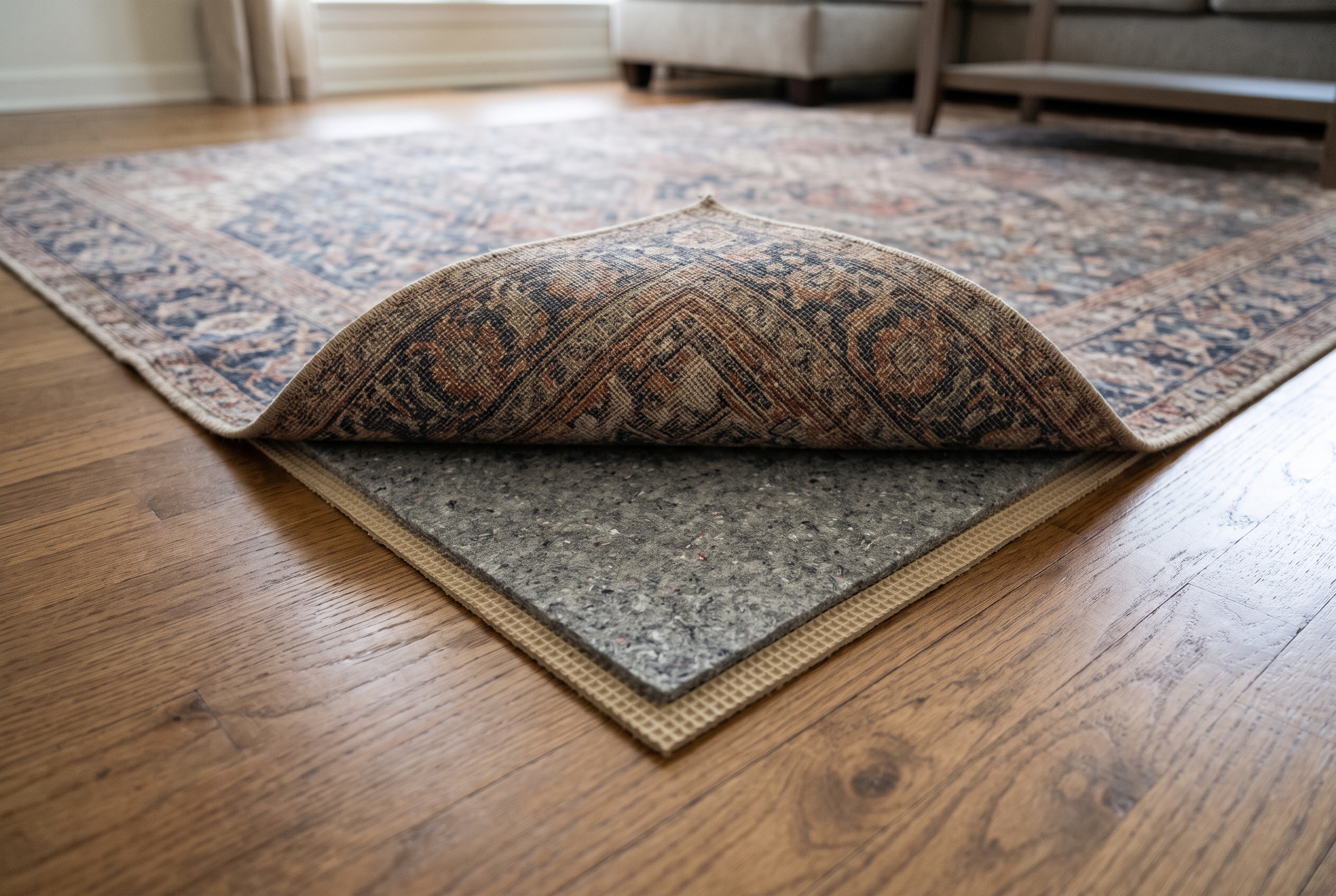
A good rug pad protects a wood floor, and the wrong one can mark it for good. Three kinds of pad cause trouble: cheap PVC or vinyl pads, which often look like a plastic waffle; pads with a sprayed-on rubbery coating; and anything held down with adhesive. Left in place for months, they can stain, stick to or soften the clear finish that protects the wood. The pads we'd put on a wood floor are felt, solid natural rubber, or felt bonded to natural rubber. Choose one that covers nearly the whole rug, and keep rugs off a freshly refinished floor for several weeks while the finish hardens.
How a Rug Pad Can Damage a Wood Floor
What you see and touch on a wood floor is mostly its finish, the clear coat over the wood that takes the wear. Anything that sits on a floor for months sits on that finish, and that's where pad damage starts.
The first problem is what the pad is made of. Soft plastics and some rubbery coatings contain chemicals that keep them flexible, and over time, especially in a warm, sunny spot, those chemicals can work their way into a floor finish. The result is a yellowed or darkened patch, or the pad's waffle pattern printed into the finish. Pads held down with adhesive can bond to the finish and pull at it when they're lifted.
The second problem is grit and wear. Cheap foam and coated pads break down into crumbs and powder, and a rug sliding on a worn-out pad grinds whatever dirt has worked under it into the finish. The third is water. A spill or a pet accident that soaks through a rug ends up trapped against the floor under the pad, where it can sit for days without anyone knowing.
Do You Need a Pad Under a Rug on Hardwood?
For most rugs, yes. The back of a rug is often stiff or rough, and as the rug shifts underfoot it rubs the finish like fine sandpaper. A rug with nothing under it also slides, which is hard on the floor and easy to trip on. A pad stops both.
What you do want to skip is a rug with a rubber or latex coating on its back, the kind many washable rugs and bath mats have. We'd steer you away from those on any wood floor. On the Mohawk hardwood we sell, the maker's care instructions rule out rubber- and latex-backed rugs entirely, and that's the rule we follow. A separate pad, made of the right material, does the gripping without that coating.
Which Rug Pads Are Safe on Hardwood
Felt is the gentlest. It cushions the rug, protects the floor and quiets footsteps, but it doesn't grip much on its own, so it suits big, heavy rugs that sit under furniture and don't move.
Felt bonded to natural rubber is the all-round choice. The felt side cushions the rug, and the rubber side grips the floor and keeps the rug from creeping. For most living room and bedroom rugs, this is the pad we'd pick.
Solid natural rubber is thin and grippy with almost no cushion. It's the one for a rug that keeps sliding, a hall runner, or a rug by a door where there's no room for anything thicker.
The pads to avoid on wood are PVC or vinyl pads, which are usually the cheapest and often have the waffle grid; pads with a sprayed-on latex or rubbery coating; foam pads that crumble; and anything with adhesive on it.
| Pad | What it does | Best for | On a wood floor |
|---|---|---|---|
| Felt | Cushions and protects, little grip | Large rugs under furniture | Safe |
| Felt bonded to natural rubber | Cushion plus grip | Most rugs | Safe |
| Solid natural rubber | Thin grip, little cushion | Runners, rugs by doors | Safe |
| PVC or vinyl, sprayed coatings, adhesive | Cheap grip | Nothing on wood | Can stain or stick to the finish |
How to Tell What a Pad Is Made Of
Start with the label. Words like 100 percent natural rubber, solid rubber or felt are what you want to see. If you see PVC, vinyl or synthetic latex, the man-made rubber used in sprayed coatings, look elsewhere, and be wary of a pad sold as "non-slip" with no material listed at all. If the label is long gone, the pad itself tells you a lot. A thin, shiny plastic grid with holes in it is usually PVC. A pad that smells strongly of plastic or chemicals is suspect. And a pad that has gone crumbly or tacky has broken down, whatever it was made of.
The Right Pad for Each Rug and Room
A living room rug gets walked on and lounged on, so it's worth a pad with some cushion: felt bonded to rubber, thick enough to feel. A dining room rug needs the opposite. A thin, firm pad of natural rubber, or a thin felt-and-rubber pad, lets the chairs slide in and out without the rug bunching up.
A hall runner needs grip more than cushion, so a thin natural rubber or felt-and-rubber pad that runs its full length is the one. A rug by a door needs the thinnest pad you can find, so the door still clears it.
Heavy furniture is where a rug earns its keep. A rug under a sofa or a bed helps keep the legs from denting the wood, and a dense felt pad spreads the weight further. Put felt protectors under the legs of anything that sits on the bare floor too.
In a home with pets or small children, the pad will eventually meet a spill or an accident. When it does, lift the rug and the pad, clean and dry the floor underneath, and let the pad dry out before it goes back down. A pad that stays damp holds that moisture against the wood.
How Big a Rug Pad Should Be
A pad should cover nearly the whole rug, stopping about an inch short of the rug's edge all the way around. That way the rug's edge tapers down to the floor and lies flat instead of catching a toe, and the pad never peeks out. Most pads come in standard rug sizes and trim easily with sharp scissors. For a round rug, lay the pad down, set the rug on top and trace around it an inch inside the edge. A runner's pad gets the same inch at each end.
If you're still deciding on the rug itself, our room-by-room guide to rug sizes covers how big each room's rug should be.
Rugs on a Newly Refinished or New Floor
A floor finish feels dry within hours, but it takes much longer to harden all the way through. Put a rug and pad on it too soon and the finish can soften under them, take on the pad's pattern, or stick. Rugs typically stay off a freshly refinished floor for several weeks, and longer in humid weather, because damp air slows the finish down. The finish used on your floor decides the exact time.
Prefinished hardwood is different. Its finish is cured at the factory before the boards ever leave, so there's nothing left to harden, and a rug and the right pad can go down as soon as the floor is in.
Rug Pads on Vinyl Plank and Laminate
Vinyl plank is the one floor where rubber itself is the problem. Rubber of any kind can leave a permanent stain on vinyl, and the installation guidelines for Mohawk's SolidTech vinyl plank warn about exactly that, so on vinyl plank we'd use felt, or a pad sold specifically as safe for vinyl, and keep rubber off the floor altogether.
Laminate has a hard, sealed surface, and the instructions that come with your laminate decide which pads and mats are allowed on it. If you don't have the instructions, felt is the safe choice.
When a Rug Pad Has Already Left Marks
Lifting a rug and finding marks underneath is common, and what to do depends on what kind of mark it is.
- A sticky film or crumbs you can feel are sitting on top of the finish. Clean them off with a hardwood floor cleaner sprayed onto a soft cloth, working gently. Skip soap, wax, abrasive cleaners and anything sharp, which can damage the finish, and try the cleaner in a corner first.
- A waffle or dot pattern, or a yellowed, darkened or dull patch in the pad's shape, means the finish softened or reacted under the pad. When the mark sits only on the very surface, the finish can be lightly sanded and given a fresh coat without going down to the wood. When it runs deeper into the finish or into the wood itself, the floor needs a full sanding and refinishing.
- A pad stuck to the floor should be peeled back slowly rather than ripped up, so it doesn't take finish with it. Then clean off what's left the way you would a sticky film.
- A lighter or darker rectangle where the rug sat is the sun, not the pad. Sunlight changes the color of the floor around a rug while the floor under it stays as it was, and once the whole floor gets the same light, the color evens out over time. Leaving the rug off for a while lets it catch up. After that, moving the rug now and then and shading the floor from strong sun keep the outline from coming back.
For the marks that need more than a cleaner, NerdWallet's national cost guide puts a fresh coat of finish at about $1 to $2 a square foot and a full sand-and-refinish at about $3 to $8 a square foot. At those rates, a 12 x 15 living room comes to roughly $180 to $360 for a fresh coat, or $540 to $1,440 for a full refinish. If a mark won't clean off, we can refinish the floor and price the job for you at a free estimate.
Keeping the Floor Under a Rug in Good Shape
Every few months, and right away after a spill, lift the rug and the pad, vacuum or dust-mop the floor underneath and let it air before the rug goes back. That's how grit and trapped moisture get caught before they do any harm. While the rug is up, look at the pad. If it has flattened, gone hard, started to crumble or turned sticky, it's time for a new one.
Turning or moving rugs now and then helps the floor around them age evenly in the light. Felt protectors under the legs of chairs and tables do the rest.
Area Rugs and Hardwood at Faith and Grace Flooring
At Faith and Grace Flooring, we carry ready-made rugs in our area rug catalog, and we make custom rugs cut and bound from carpet to the size and shape your room needs. If the rug is going on a new floor, our hardwood catalog has solid and engineered hardwood to go under it.
You'll find us at 902 Dashiel St in Murfreesboro and 7305 Nolensville Rd in Nolensville.
More Questions About Rugs on Wood Floors
Are rug tape and corner grippers safe on hardwood?
Not the sticky kind. Adhesive tape and grippers can pull at the finish when they're lifted and leave a residue behind. A pad under the whole rug stops sliding without anything stuck to the floor, which is the safer way to keep a rug in place.
Do washable rugs need a pad on hardwood?
Many washable rugs have a rubbery coating on the back, and that coating is what Mohawk's care instructions rule out on its wood floors. If you want a washable rug on hardwood, look for one without a coated back and put a felt or felt-and-rubber pad under it.
How often should a rug pad be replaced?
When it stops doing its job: flattened, hard, crumbling or sticky. A good felt or natural rubber pad lasts for years. Check it whenever you lift the rug to clean under it.
Before the Rug Goes Back Down
If lifting the rug turned up more than a cleaner can fix, or you're picking out a rug for a new floor, the next step is a free in-home estimate. We'll come out, look at the floor and price what it needs.


