

Your long living room needs a rug about 9 x 17 to leave an even border of floor. The nearest stock sizes, 9 x 12 and 10 x 14, are both too short. Or a big piece of carpet left over from your new bedrooms is leaning against the garage wall, too good to throw away.
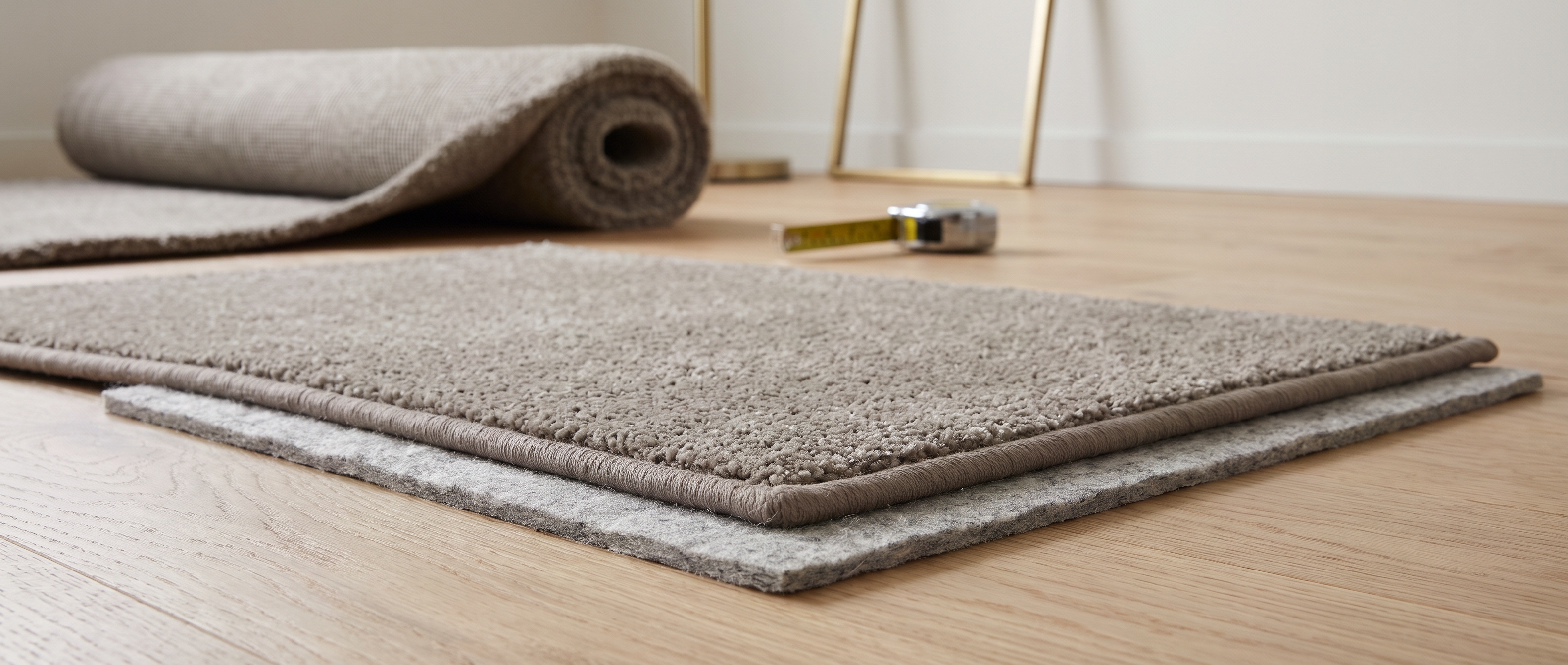
A cut-and-bound rug solves both. It's broadloom carpet, the wall-to-wall kind sold off wide rolls, cut to the size and shape you want. The raw edges are then finished with binding, a fabric tape sewn over the edge, or with serging, yarn wrapped tightly around it.
The short answer: a cut-and-bound rug is carpet cut to size with its edges bound or serged so they don't fray. It's priced in three parts: the carpet by the square foot, the edge by the foot, and a pad. At 2026 national rates, a 9 x 12 in average carpet comes to roughly $270 to $810, or about $160 to $270 if you already own the carpet.
At Faith and Grace Flooring, we make custom cut-and-bound rugs for homes around Murfreesboro and Nolensville. We cut them from any carpet in our selection or from a piece you already have. We also cut down rugs that are too big, rebind worn edges, and make hall and stair runners.
At 2026 national rates from published cost guides, each part of the price works like this:
| Part of the price | How it's priced | National range, 2026 |
|---|---|---|
| Carpet | Per square foot | $1 to $5 on average; wool costs more |
| Standard binding | Per foot of edge | About $1.50 to $4 |
| Serging | Per foot of edge | About $5 to $10 |
| Pad cut to size | Per square foot | $1 to $14 or more |
Wool carpet, cotton or leather tape, thick carpet that needs extra edge work, shapes other than a rectangle and delivery all push a total up.
How a Custom Rug Is Cut and Bound, Step by Step
A custom rug is cut from carpet, and a cut carpet edge comes apart unless it's finished. Most carpet is tufted: yarn is punched through a backing fabric and held there by latex, a rubbery glue spread across the back. Cut through it, and the tufts along the edge start to pull loose.
On loop carpet, one snagged loop can run down the row like a pulled thread in a sweater. Binding or serging seals the edge against both problems. Here's how we make a custom rug, from choosing the carpet to taking it home:
- You choose the carpet in one of our showrooms, or order free samples from our online catalog and check the color in your own light first.
- We settle the size and shape with you, then recommend the edge: binding or serging, and the tape's material and color, to suit how the rug will be used.
- We cut the carpet to your size and square it, so the corners are true and the rug lies straight.
- On thick carpet, we bevel the edge first. Beveling trims the pile down along the edge so the binding can sit flat.
- We sew the binding tape around the edge, or serge it with yarn.
- We secure the corners and the spot where the tape starts and ends.
- The finished rug goes down on a pad, which keeps it from sliding and protects the floor underneath.
How to Measure for a Custom Rug
Measure in inches, because a rug cut to the wrong size can't be uncut. Start with the floor you want covered, and decide how much floor should show around the edges. Then mark the outline with painter's tape and live with it for a day.
The tape shows traffic paths, door swings and furniture legs better than any drawing. Open every door that swings over the outline, too. The rug and its pad add height, and each door has to clear both.
For a round rug, measure the diameter. For a runner, measure the hall and subtract the floor you want showing at each end. Write the size as width by length, and have someone else check your numbers.
If you'd rather not measure, request a free in-home estimate and we'll do it for you.
How Long a Custom Rug Takes
The carpet sets the timeline more than the binding does. When the carpet is in stock, or you bring your own piece, the rug comes down to cutting, edging and finishing the corners. We aim to get custom rugs back to you quickly.
When the carpet has to be ordered from the mill, its delivery time comes first. Ask us for the ready date when you order, and plan around it if the rug is for a move or an event.
What a Custom Cut-and-Bound Rug Costs
A custom rug costs the carpet, plus the edge, plus a pad. The carpet and pad are priced by the square foot, and the binding or serging by the foot around the rug. These are 2026 national ranges from published cost guides, so use them to set a budget before you come in.
The Carpet, Priced by the Square Foot
Carpet is the biggest part of the bill for most rugs. Nationally, HomeGuide's 2026 figures put carpet at $1 to $5 a square foot on average, for the material alone. Builder-grade carpet starts around 50 to 75 cents a square foot, and medium to high-quality carpet runs $2 to $10.
Carpet is also priced by the square yard. A square yard is 9 square feet, so $27 a yard works out to $3 a foot.
The roll's width decides how much carpet you pay for. Carpet comes off rolls of a set width, and your piece is cut as a length across that whole width. A 9 x 12 or a 12 x 15 cut from a 12-foot roll uses the full width and wastes nothing.
An 8 x 10 cut from the same roll leaves a strip 2 feet wide and 8 feet long. Ask us how that strip is priced on the carpet you choose, and whether it can be bound into a mat at the same time.
Remnants cost less. A remnant is the end of a roll left over from other jobs, and it sells at a discount because you take whatever colors and sizes are left. Ask us whether there's one in the size you need.
The Edge, Priced by the Foot Around the Rug
The edge is priced by the linear foot, meaning every foot of the rug's outline. RemodelCalculators' September 2026 national figures put standard binding at about $1.50 to $4 a foot, and serging at about $5 to $10.
A January 2026 House Digest roundup puts narrow synthetic binding higher, at $2 to $8 a foot. Prices move with the tape, the thickness of the carpet and where you live.
To price an edge, multiply the rug's outline by the rate. A 9 x 12 has 42 feet of edge. The table covers common sizes at the RemodelCalculators rates:
| Rug size (feet) | Feet of edge | Standard binding | Serging |
|---|---|---|---|
| 2.5 x 8 runner | 21 | $32 to $84 | $105 to $210 |
| 5 x 8 | 26 | $39 to $104 | $130 to $260 |
| 6 x 9 | 30 | $45 to $120 | $150 to $300 |
| 8 x 10 | 36 | $54 to $144 | $180 to $360 |
| 9 x 12 | 42 | $63 to $168 | $210 to $420 |
| 10 x 14 | 48 | $72 to $192 | $240 to $480 |
| 9 x 17 | 52 | $78 to $208 | $260 to $520 |
| 12 x 15 | 54 | $81 to $216 | $270 to $540 |
| 8-foot round | About 25 | $38 to $101 | $126 to $251 |
Does a Cut-and-Bound Rug Need a Pad?
Yes, a cut-and-bound rug needs a pad. Mohawk Home recommends a pad under every rug it sells. A pad protects the floor from scratches and color transfer, adds grip and cushion, and reduces pile crush, the flattening of the yarn under traffic.
Mohawk Home also says to cut the pad at least 2 inches smaller than the rug on every side. That lets the edge lie flat against the floor, where it can't catch a foot.
A January 2026 House Digest roundup puts a non-slip pad cut to your rug's size at $1 to more than $14 a square foot. Thickness and quality decide where yours falls, and at the low end, a pad for a 9 x 12 adds about $100.
Match the pad to the floor under it. On luxury vinyl plank, use a pad the floor's maker allows. Mohawk's SolidTech vinyl instructions warn that prolonged contact with rubber can permanently stain the floor.
A loose pad can be replaced later without touching the rug. An attached one travels with the rug, which helps if you move it often.
The Extras
The extras are what make two prices for the same rug differ. Cutting and squaring, beveling thick carpet, shapes other than a rectangle and delivery can each add to the bill. When you compare prices, check what each one includes.
We price each rug upfront, once we know the carpet, the size and the edge. When you're ready for a number on yours, request a free estimate.
Five Rugs Priced Out
Priced at the same national rates, room-size rugs in average carpet cost hundreds of dollars, and a large wool rug costs thousands. The table uses HomeGuide's average carpet price, the RemodelCalculators edge rates and a basic pad at $1 a square foot.
| Rug | Carpet | Edge and basic pad | Rough total |
|---|---|---|---|
| 9 x 12, average carpet, bound | $108 to $540 | $164 to $269 | About $270 to $810 |
| 9 x 17, average carpet, bound | $204 to $1,020 | $222 to $352 | About $430 to $1,370 |
| 2.5 x 12 hall runner, bound | $30 to $150 | $69 to $141 | About $100 to $290 |
| 12 x 15 wool, serged | $2,160 to $2,700 | $441 to $711 | About $2,600 to $3,410 |
| 8 x 10 from your own leftover | Already paid for | $128 to $218 | About $130 to $220 |
The 9 x 17 assumes you pay for the full 12-foot width of the cut, 204 square feet of carpet. That leaves a strip 3 feet wide and 17 feet long. Binding it into a hall runner would add about $60 to $160 at the same edge rates.
The hall runner is cut across a 12-foot roll, which uses the carpet with no waste. The wool row uses typical wool carpet at $12 to $15 a square foot.
Ways to Spend Less
- Use carpet you already own, or ask about a remnant before ordering from a full roll.
- When the room allows it, pick a size that uses the full roll width, such as 9 x 12 or 12 x 15.
- Choose standard polyester binding over cotton, leather or serging.
- Keep the shape a rectangle, since curves and cutouts take more cutting and edge work.
- If you're paying for a leftover strip, have it bound into a mat or runner at the same time.
Should You Buy a Custom Rug or a Ready-Made One?
It depends on the size, the fiber and whether you already own the carpet. We sell both ready-made and custom rugs, and here's how we'd decide. In a standard size and a basic synthetic, a mass-produced rug is often the cheaper buy.
A custom rug gives up the savings of mass production, because it's cut one at a time to one order. With a ready-made rug, you also see the finished rug before you buy it.
A custom rug is the better buy when no stock size fits. It's also the better buy when you want a particular carpet fiber such as triexta or wool, or when the rug should match carpet elsewhere in the house. Binding carpet you already own is the cheapest route of all, since you pay only for the edge and a pad.
Our ready-made area rugs come from makers such as Nourison, Milliken and Jaipur Living. If one fits your room, start there.
Online made-to-order rugs are a third route. A rug company makes the rug to your size, prices it by the square foot of finished rug and ships it. You choose from photos and small samples.
Side by side, the two main options compare like this:
| Question | Cut-and-bound from carpet | Ready-made rug |
|---|---|---|
| Sizes? | Any size up to the roll's width, any length | Standard sizes |
| Fibers? | Any carpet, including triexta and wool | Whatever the rug line offers |
| Look? | The texture of the carpet it's cut from | Woven, printed or tufted rug designs |
| See it first? | You choose from carpet samples | You see the finished rug |
| Edges? | Bound or serged to your choice | Finished by the maker |
| Wait? | Cutting and binding time, plus mill delivery if the carpet is ordered | Ready if in stock, or the maker's delivery time |
| Price? | Carpet plus edge plus pad | A set price by size |
Which Carpets Make the Best Rugs
The best carpets for rugs are dense, with a low to medium pile and a tight twist. Pile is the carpet's yarn surface, and twist is how tightly each yarn is wound. A rug takes steady traffic in the same spots, and dense yarn holds itself upright longer.
Density matters more than the fiber name. As our comparison of triexta, nylon and polyester explains, a dense polyester will outlast a thin, loosely tufted nylon. A thin carpet mats down in the traffic path, and our guide to matted carpet explains why.
Test a sample before you choose. Fold it backward with the pile facing out. If the backing shows between the tufts, the carpet will crush sooner.
Fiber decides how a rug handles spills, pets and traffic. Here's how the four fibers you'll see most often compare:
| Fiber | Good for | Watch for | Carpet per sq ft (HomeGuide, 2026) |
|---|---|---|---|
| Nylon | Hallways, stairs, heavy traffic | Needs factory stain protection; costs more | $0.75 to $9 |
| Triexta | Kids, pets, spills | Heaviest traffic favors dense nylon | $1.50 to $7 |
| Polyester | Bedrooms, soft feel, rich color | Crushes sooner; holds oily soil | $0.50 to $6 |
| Wool | Living rooms, long life | Cost, moisture, bleach | $3 to $25; most $12 to $15 |
Among the synthetics, prices overlap widely, and only wool stands apart on cost.
For a rug by a sunny window or in a mudroom, ask for solution-dyed nylon. The color goes into the fiber before it's spun, so it holds up to sunlight and even survives diluted bleach.
A few choices make a bound carpet look like a real rug. Patterned, textured and loop styles read as rugs more readily than a plain plush does. A generous size looks deliberate, and a pad underneath gives the rug some heft.
Triexta Rugs for Kids, Pets and Spills
For dogs, kids and spilled juice, look at triexta. Triexta is a newer carpet fiber with stain resistance built into the fiber itself, so there's no coating to wear off. Mohawk sells it as SmartStrand, and Mohawk Home says rugs made with SmartStrand permanently resist stains and spills for the life of the rug.
You can get triexta as a ready-made rug, since Mohawk Home makes rugs with SmartStrand, or as triexta carpet cut and bound to your size. Both our showrooms keep triexta next to nylon and polyester, and our triexta carpet page explains how the fibers compare.
Skip loop pile if you have pets. Mohawk Home warns that looped pile is the construction pet claws snag most easily.
Wool Rugs Cut From Wool Carpet
Wool makes the most luxurious cut-and-bound rugs, and the most expensive. HomeGuide's 2026 wool guide puts most wool carpet at $12 to $15 a square foot and wool blends at $5 to $14. Its broader carpet price guide lists wool from as little as $3, so grades vary widely.
If you want wool on a budget, ask about remnants. HomeGuide's wool guide notes that remnants from premium wool rolls can sell for 40 to 60 percent below retail, in whatever colors and sizes are left.
Wool springs back and hides soil well, but it absorbs moisture, and bleach destroys it. Through a humid Middle Tennessee summer, keep a wool rug out of damp rooms, and let it dry fully after any spill or cleaning. Our guide to choosing carpet for your climate explains why synthetics handle damp better.
Loop, Plush and Patterned Carpets
Loop carpet makes a good rug when its edge is sealed well. Often sold as Berber, it keeps its yarn in uncut loops, and a snagged loop at a cut edge can run down the row. Our guide to cut, loop and textured pile explains how each type wears.
Thick plush and shag take extra edge work before binding, which adds to the cost.
Patterned carpet makes striking rugs. Tell us where you want the pattern to fall so it looks even at every edge, and browse our carpet collection with that in mind.
Matching the Carpet to the Room
Choose the carpet for the room the rug will live in. In a family room or a kids' room, dense triexta or nylon holds up to traffic and spills. Under a dining table, a low, dense pile lets chairs slide out without catching, so skip a thick pad there.
A bedroom sees light traffic, which makes soft polyester a sensible place to save. For entries, mudrooms, laundry rooms and basements, choose a low pile in solution-dyed nylon, in one of the carpet colors that hide stains best.
In a home office, a desk chair's wheels grind a rug down fast. Put a chair mat on top, or keep the chair's path off the rug.
Turning Leftover Carpet or a Remnant Into a Rug
Leftover carpet from your own installation is already paid for, and it matches the rooms it came from. We bind new or used carpet, so a piece like that can become a rug for the cost of its edge and pad. Before you bring it in, check four things:
- It's big enough once the edges are trimmed straight, which usually takes a few inches off each side.
- It's clean and dry, with no water damage, pet stains or odor in the backing.
- It was stored rolled up, with no folds, so the backing has no hard creases.
- If it was ever installed, the strip along the old tack strip will be trimmed off. A tack strip is the wooden strip of pins that holds carpet at the walls, and it leaves that edge full of holes.
A rug cut from the same roll as your wall-to-wall carpet matches it exactly. Carpet ordered later can come from a different dye lot, meaning a different production batch, and its color can differ slightly. If we're installing carpet in your home now, ask us to add a few feet to the order for a matching rug.
A remnant goes through the same checks before it's bound.
Cutting Down a Rug You Already Own
Whether a rug can be cut down depends on how it's made. We can cut down tufted and machine-made rugs, including rugs made from carpet, and bind the new edge the same way we finish a new rug. Hand-knotted and flat-woven rugs are a job for a rug restorer, because cutting across their threads lets the knots and weave come apart.
Turn the rug over to find out which you have. A tufted rug has a fabric or canvas backing, often with a rubbery latex layer showing at a worn edge. A hand-knotted rug shows its pattern clearly on the back, knot by knot. Its fringe is the ends of the threads that run the length of the rug.
A flat-woven rug, such as a kilim or dhurrie, is woven flat with no pile and looks nearly the same on both sides.
On a machine-made rug with a printed or woven border, cutting removes the border on that side. Taking the same amount off two opposite sides keeps the design balanced.
Restorers can shorten or narrow a hand-knotted rug when the pattern allows. They tie off the threads by hand and build a new edge to carry the load, and the cut is permanent.
For a tufted or machine-made rug, the cost follows the same per-foot pricing as any binding, plus the cut. Our area rug binding service also refreshes worn edges on older rugs, which can add years to a rug you like.
How Big a Custom Rug Can Be, and Which Shapes Work
A custom rug can be as wide as the roll it's cut from, and almost any length. Carpet rolls are commonly 12 to 15 feet wide, and some carpets come wider. Ask us for the width of the carpet you choose, because that width sets the widest rug you can have in one piece.
The 9 x 17 living room rug fits on a 12-foot roll in one piece.
Go wider than the roll in both directions, and the rug needs a seam. A seam will show, and Mohawk's carpet warranty states plainly that there are no invisible seams.
The pile on both pieces also has to lean the same way. Pile that leans in different directions reflects light differently, an effect called shading, and the two halves can look like two colors.
A room-size rug also gives you the feel of carpet without installing it. Stopped a foot or so short of the walls, it suits a rental or a floor you want to protect, with nothing nailed down.
Shape is rarely the limit, because we cut carpet to the shape your space needs. Rooms that often call for a custom size or shape:
- A long living room that needs a 9 x 17 to leave an even border of floor.
- A 3 x 22 runner for an upstairs hallway.
- A rug notched around a fireplace hearth. Near the opening, wool is the safer fiber, and our guide to carpet near a fireplace covers the options.
- An L-shaped rug that follows a sectional sofa.
- A round rug under a round dining table.
A round or oval rug is cut from a rectangle. An 8-foot round uses an 8 x 8 piece, 64 square feet of carpet, for about 50 square feet of rug. Curves also take slower edge work than straight sides.
Big rugs are heavy. Before ordering a 12 x 18, plan how it will get through the doors and who will carry it, and ask us about getting it home.
Choosing the Edge Finish
Binding gives a clean, tailored border at a lower price, and serging gives a softer, hand-finished look for more. Binding is a flat fabric tape folded over the edge and sewn through. Serging is yarn stitched tightly around the edge.
We bind in cotton, polyester or leather tape. Polyester costs the least and wears well, cotton has a softer look, and leather makes a heavier, more formal border.
A tape that matches the carpet disappears, and a contrasting one frames the rug like a border. Bring the carpet or a sample when you choose, and we'll help you pick the material and color.
Hall Runners and Stair Runners Cut From Carpet
Runners are the easiest custom rugs to justify, because hallways and staircases rarely match stock lengths. We cut hall runners to any length. Cut across a 12-foot roll, a runner up to 12 feet long uses the carpet with no waste.
A longer runner is either cut along the roll, which leaves a wide strip beside it, or pieced from shorter lengths, which puts seams in the hall. A strip left along the roll can become a second rug.
Almost any durable carpet can become a stair runner. Plan for an even reveal, the strip of wood showing on each side, of about 4 to 7 inches, depending on how wide your stairs are.
Our guide to carpet on stairs explains the reveal, and why a runner has to be tight at the edge of every step. Our guide to the best carpet options for staircases compares the carpets that hold up there.
A stair runner usually costs more per step than carpeting the whole stair. Nationally, HomeGuide's 2026 guides put carpeting a straight staircase at $15 to $55 a step, and an installed stair runner at $40 to $100 a step.
For 12 to 16 steps, that's $480 to $1,600 for the runner. L-shaped, U-shaped and curved stairs cost more per step either way.
Part of the difference is finishing. Both long edges of a runner are bound or serged, and it has to be centered on the stairs. It's also installed step by step, while an area rug simply lies on a pad.
We design and install custom stair runners, cut to the exact dimensions of your staircase, with wool, nylon and pet-friendly options.
A runner that moves is a fall risk, so a stair runner is always installed, never laid loose. The National Institute on Aging's fall-prevention checklist for older adults asks that all carpets be fixed firmly to the floor. It also advises against throw rugs and small area rugs altogether.
If someone in your home is unsteady on their feet, our guide to flooring for aging in place covers safer choices.
Can You Bind a Rug Yourself?
Yes, you can bind a small rug yourself if it sits in a low-traffic spot. Peel-and-stick binding tape presses along the cut edge. One tape maker's instructions then add a 1/8-inch bead of hot glue between the tape and the carpet to hold it.
Straighten the edges first with a carpet knife and a straightedge. Work the tape around one side at a time, snip it at the corners, and seal the joint where the two ends meet.
The limits show on bigger jobs. A glued edge holds less securely than a sewn one, thick carpet can't be beveled at home, and a household sewing machine isn't built for carpet. For a room-size rug, a runner, stairs, wool or patterned carpet, a machine-bound edge is worth the per-foot price.
Warranties and Returns on Custom Rugs
Carpet warranties are written for installed carpet, so check what carries over to a rug before you count on it. Mohawk's current carpet warranty, effective March 1, 2026 and covering SmartStrand, extends to area rugs only through Mohawk's own custom rug program.
Rugs from that program carry a one-year limited warranty against manufacturing defects. They can be returned only for freight damage, defective workmanship or a failure to meet the ordered specifications.
A rug cut to your order generally can't be returned like a stock rug. Before we cut, check the size, shape, edge and color on your order, and measure twice.
Judge the color from a large sample in the room itself, in daylight and again under lamps. Our guide to choosing floor colors for Middle Tennessee light explains how much a color can shift.
We guarantee a high-quality finish that meets your expectations. If something about the binding isn't right, tell us.
Caring for a Cut-and-Bound Rug
Caring for a cut-and-bound rug takes the same routine as the carpet it came from, plus some attention at the edges. In the first few weeks, you're helping it settle. After that, most of the work is vacuuming gently and keeping the sunlight even.
How Long a New Rug Takes to Settle
A new bound rug takes a few weeks to settle. It may show creases from being rolled, and its corners can lift at first. Creases from rolling are common, and most flatten out over several weeks.
If a corner stays up, roll that end the opposite way for a day, or set something heavy on it overnight with the pad in place.
Vacuuming, Cleaning and Rebinding
When vacuuming a bound rug, go easy on the edges. Mohawk Home warns that beater bars and brushes, or a vacuum set too low, can fray a rug's edges and wear its face. Turn the beater bar off entirely on thick loop, shag or frieze, a tightly twisted, shaggy style.
Blot spills right away, and have the rug professionally cleaned when traffic lanes start to show. Rotate it a couple of times a year so sunlight ages the floor around it evenly. Our guide to preventing sun damage on hardwood and laminate explains why.
When the binding finally wears, we can rebind it. A fresh edge gives a good rug years more.
Questions About Cut-and-Bound Rugs
Does a Rug Cut From Carpet Shed?
Yes, a rug cut from cut-pile carpet, the kind with the yarn loops sheared into upright tufts, sheds loose fibers at first, and that's normal. Mohawk's carpet warranty describes shedding as a normal trait of cut-pile carpet. Regular vacuuming clears it, and it tapers off as the loose fiber from manufacturing works out.
Can You Bind a Rug That Has Fringe?
Yes, if the fringe was sewn on, as it usually is on tufted rugs. We can remove the fringe and bind the end. On a hand-knotted rug, the fringe is the ends of the threads that hold the rug together, so it stays, and any repair goes to a rug restorer.
Can a Cut-and-Bound Rug Go Outside?
No, unless it's cut from carpet made for outdoor use and finished with an edge meant to get wet. Mohawk Home sells separate outdoor rugs made to hold their color and shape outside, and it doesn't recommend putting a regular indoor rug out there.
Can You Put a Bound Rug on Top of Wall-to-Wall Carpet?
Yes, with a pad made for carpet underneath, so the rug doesn't creep. Mohawk Home's dual-surface pad, for example, goes felt side down on carpet and latex side down on hard floors. A low, dense rug sits more steadily on carpet than a plush one.
Can You Bring Your Own Carpet to Be Bound?
Yes. We bind new or used carpet, so a leftover piece from your own installation or an older rug with a worn edge can come in. Bring it to either showroom, and we'll tell you what size it will give you once the edges are squared.
Where to Get a Rug Cut and Bound in Murfreesboro and Nolensville
You can order a custom cut-and-bound rug at either of our showrooms, 902 Dashiel St in Murfreesboro or 7305 Nolensville Rd in Nolensville. We've been putting carpet on Middle Tennessee floors since 1981, and we'll help you choose the carpet and the edge for your room.
Bring these with you:
- The measurements of the space in inches, with a quick sketch of doorways, floor vents and anything the rug has to fit around.
- A few photos of the room in daylight.
- The carpet itself if you're using your own, rolled up with no folds.
- A note of pets, kids, a desk chair on wheels, or a door that swings over the rug.
Our guide to shopping a flooring showroom covers what else to bring and ask. You can also read reviews from our customers in both towns.
Have a room no stock size fits, carpet left over in the garage or a hallway that needs a runner? Request a free estimate, and we'll measure the space and price the rug you have in mind.