

You've picked the perfect laminate plank — the color is right, the texture feels authentic, and the durability checks every box. Then comes a question most people don't think about until the boxes are stacked in the hallway: which direction should the planks run? Or maybe the better question is: what pattern will make this room unforgettable?
Flooring layout is one of the most overlooked design decisions in a renovation, yet it shapes how every other element in the room feels. The same box of laminate can read calm and traditional or bold and architectural depending entirely on how the installer arranges it. For homeowners in growing communities like Murfreesboro and Nolensville — where builder-grade floors often beg for an upgrade — understanding these options turns a simple swap into a transformation.
Why Layout Pattern Changes Everything
A plank running parallel to the longest wall elongates a narrow space. That same plank laid perpendicular makes the room feel wider. These are the fundamentals, but they only scratch the surface. Laminate, because it's precision-milled with consistent dimensions from plank to plank, opens up geometric possibilities that installers once reserved for costly site-finished hardwood.
The difference between a standard straight-lay and something more considered is the difference between a floor that simply covers the subfloor and one that anchors the entire room's design. When you walk into a space with a thoughtfully patterned floor, your eye moves differently. The room has rhythm. It feels finished — not just furnished.
Before settling on a layout, it helps to browse the range of textures and plank dimensions available. Our laminate selection includes wood-look planks from brands like Mohawk, Mannington, and Pergo that handle these installation styles beautifully. And if you're weighing laminate against other materials, the laminate flooring guide walks through wear layers, water resistance, and what to expect from modern manufacturing.
Herringbone: The Pattern That Signals Craft
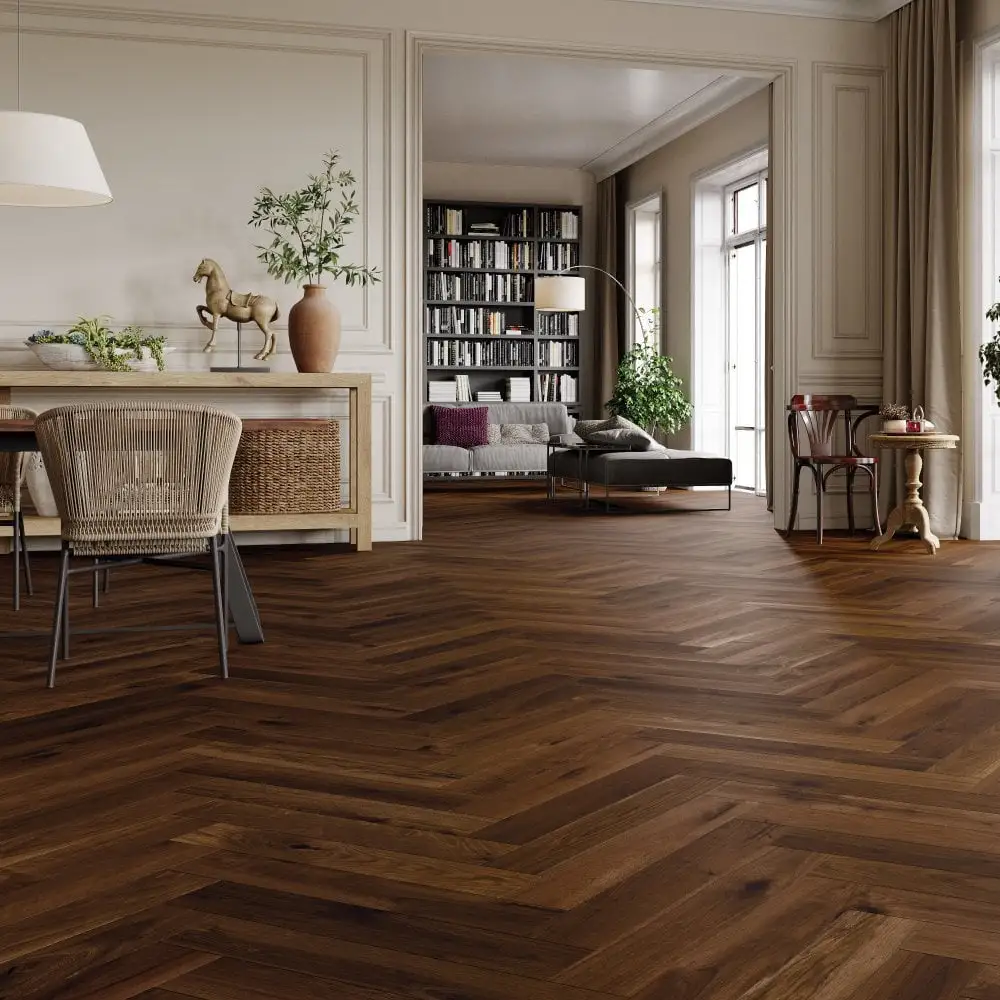
Herringbone is having a moment — though in truth, it never really left. The pattern dates back to Roman road-building, where interlocking V-shapes distributed weight better than straight lines. In flooring, it delivers something equally practical: a visual anchor that makes rooms feel both wider and more intentional.
With laminate, herringbone achieves something remarkable. The same click-lock technology that makes standard installation straightforward gets applied to smaller, precision-cut planks arranged in those characteristic 90-degree breaks. The result reads as custom millwork at a fraction of the cost. It works especially well in entryways, dining rooms, and master suites — spaces where you want the floor to make a statement before any furniture arrives.
One caveat: herringbone demands more material. The angled cuts produce waste that a straight lay avoids entirely, so most installers recommend ordering 15–20% extra for the pattern alone, on top of the standard overage. It's also slower work, which is why you want a crew that has done it before — not someone learning on your living room floor.
Diagonal and Beyond: Less Common, Equally Striking
If herringbone feels too formal, a diagonal layout offers a subtler twist. Running planks at a 45-degree angle to the walls draws the eye outward toward the corners, making compact spaces feel larger. It's a favorite trick for condos, basement remodels, and awkwardly shaped rooms where standard parallel lines would only emphasize the irregular footprint.
Then there are offset patterns that fall somewhere between standard and showpiece. A random staggered layout mimics the organic variation of real hardwood, with end-joints placed at varying distances rather than a uniform step pattern. A brick-bond pattern — also called running bond — keeps joints aligned at the midpoint of the adjacent plank, creating clean horizontal lines that suit modern, linear interiors.
Not every laminate product supports every pattern. Checking the manufacturer's specifications before committing to anything beyond a standard lay saves headaches later. Some click-lock systems are engineered specifically for herringbone, while others require glue-assist at the pattern breaks.
The Installer Makes the Pattern
A beautiful pattern only works if the subfloor preparation and cutting are precise. Uneven subfloors, rushed layout lines, or poorly staggered end-joints will turn a premium plank into a disappointment no matter which direction it runs. That's why working with experienced installers matters — especially for complex geometries like herringbone and diagonal lays.
Faith and Grace Flooring has served Rutherford County since 1981, with certified installers who've handled everything from straightforward plank replacements to intricate custom layouts. You can learn more about our story and the team behind every installation. If you're ready to move beyond builder-grade basics and explore what the right laminate pattern can do for your home, start with a free estimate. Bring your room dimensions and your ideas — the pattern is just the beginning.