

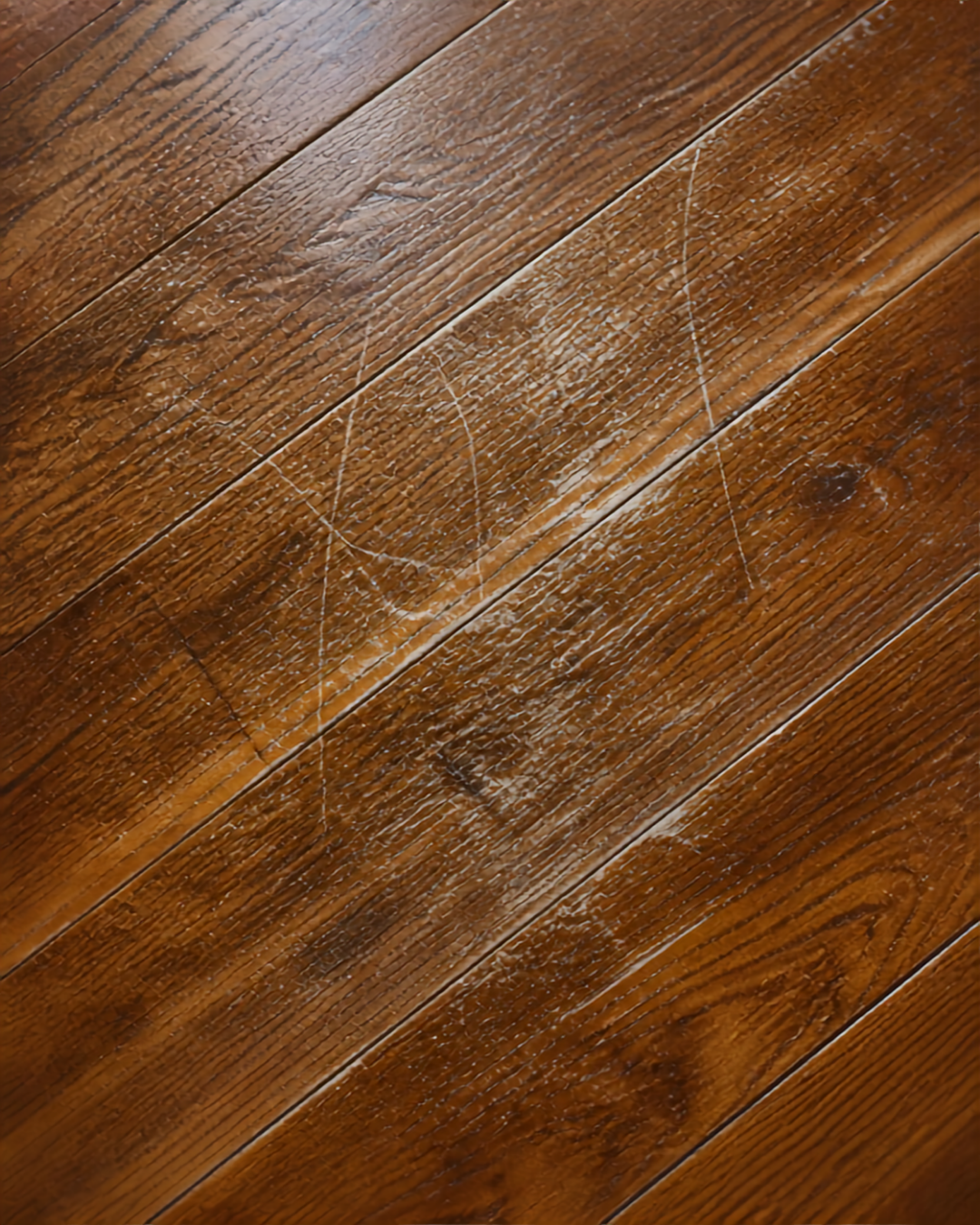
The dog came through the back door at speed. Or the dining chair got dragged instead of lifted. Now there is a pale line across your floor that catches the light every time you walk past it, and you cannot stop seeing it.
Before you buy anything off a hardware store shelf, two tests tell you what you are actually dealing with. Both take under a minute.
The Short Answer
Most scratches are in the finish, not in the wood. That is good news, because damaged finish can usually be renewed without replacing anything.
If your fingernail does not catch in the scratch, it is surface-level and a light abrasion plus a fresh coat will erase it. If your nail catches, the damage has reached the wood and needs filling, spot repair, or sanding.
Laminate is the exception. It cannot be sanded or refinished at all, so a damaged laminate plank gets replaced rather than repaired.
Why the Finish Matters More Than the Wood
A hardwood floor is wood with a clear coating over it. That coating does all the work. It takes the grit, the chair legs, the claws and the sunlight, and it wears out on a schedule while the wood underneath stays untouched.
Which means most floors that look worn out are not worn out at all. The wood is fine. The layer protecting it has thinned in the places you walk most. Everything you dislike about how the floor looks is happening in a coating a fraction of a millimeter thick.
That distinction decides your repair, your cost, and how much of your house is out of action.
Two Tests You Can Do Right Now
The fingernail test
Drag your fingernail slowly across the scratch, at right angles to it.
If your nail glides over without catching, the scratch is in the finish only. This is the common case, and it is the cheap one.
If your nail drops into the scratch, it has gone through the finish into the wood. Different repair, more work.
The water drop test
This one tells you the condition of the finish across the whole floor, which matters more than any single scratch. Put a few drops of water on the floor in a busy traffic lane. Put a few more in a spot nobody walks on, such as under a piece of furniture or inside a closet.
Wait a couple of minutes, then look.
If the water beads up and sits on the surface, your finish is intact. Wipe it up and relax.
If the water soaks in and darkens the wood, the finish has worn through in that spot and the wood is now exposed. Wipe it immediately. That area needs attention before a spill does real damage.
Comparing the traffic lane against the protected spot is what makes this test useful. It shows you how much finish you have actually used up.
Surface Scratches: Screen and Recoat
When the finish is scratched but not worn through, and the wood is undamaged, the fix is a screen and recoat. It is also called a buff and coat.
A machine lightly abrades the existing finish to roughen it, the floor is cleaned thoroughly, and one fresh coat of finish goes on top. The old finish stays. Nothing is sanded down to bare wood.
It takes about a day, costs far less than a full refinish, and produces almost no dust because nothing is being removed. For a floor covered in fine pet scratches and dulled traffic lanes, it is transformative.
Two things stop it working. If the finish has already worn through to bare wood in places, a recoat will not blend those areas back in. And if the floor has been treated with certain polishes, the new coat will not stick, which is covered further down.
Deeper Damage: Gouges, Dents and Board Replacement
Once your nail catches, you are past what a recoat solves.
A dent is different from a gouge, and the difference decides whether you can fix it yourself. A dent is compressed wood fibers with nothing torn. A gouge has fibers removed.
Dents in solid hardwood can sometimes be raised. A damp cloth over the dent and a warm iron held on it briefly swells the crushed fibers back up. It works surprisingly well, though it will affect the finish over the spot, so expect to need a touch-up afterward.
Do not try this on engineered hardwood or laminate. Engineered boards have a thin wood layer bonded to a core, and heat and moisture can separate them. On laminate it does nothing useful and can bubble the surface.
Gouges get filled or replaced. A small one can be filled with a wood filler tinted to match and then coated over. A large one, or several in one board, is usually a board replacement.
Dark Stains: The Honest Bad News
Black or gray patches are a different problem from scratches, and they are the one repair worth setting expectations on early.
When water or pet urine gets through the finish and into the wood, it reacts with tannins in the wood and stains it from within. That color is in the wood fibers, not on the surface.
Sanding removes a thin layer of wood. A stain that has soaked deep often survives it, which is why a floor can be professionally sanded and still show shadows where the damage was. Sometimes the answer is replacing those boards.
If the stain came from a leak, find the leak first. Our guide to squeaks and soft spots covers how to tell surface damage from a problem underneath the floor.
Laminate Is a Different Problem Entirely
Everything above assumes real wood. Laminate works differently, and the difference is absolute.
The wood grain on a laminate floor is a printed photograph under a clear wear layer. There is no wood to sand into. Sanding a laminate floor removes the image and leaves you with a gray board.
So laminate cannot be refinished, recoated, or screened. Your options are narrower and simpler.
Small chips and shallow scratches can be filled with a color-matched repair putty or wax pencil made for laminate. It is a cosmetic fix and it works well enough on a scratch you notice only at certain angles.
Anything worse means replacing the plank. If your laminate floats, which most does, planks can be unclicked from the nearest wall and worked back to the damaged one. If the damage sits in the middle of a large room, an installer can cut the bad plank out and drop in a replacement.
This is the argument for keeping two or three spare boxes after any laminate installation. Production runs change, and a plank bought three years later rarely matches. Our explanation of laminate wear layers and AC ratings covers how much abuse a given laminate is built to take in the first place.
How Many Times Can Hardwood Be Refinished?
Sanding removes roughly a thirty-second of an inch each time. What limits you is how much wood sits above the tongue, the interlocking edge that holds the boards together.
Solid three-quarter-inch hardwood has a healthy amount of wood above the tongue and can typically take several sandings across its life. Floors in older homes have often been done more than once already.
Engineered hardwood depends entirely on its wear layer, meaning the thickness of real wood bonded to the top. A generous wear layer can usually take a sanding or two. A thin one cannot be sanded at all, and attempting it goes straight through into the core.
If you do not know which you have, look at an exposed edge at a doorway or a floor vent. Solid wood shows the same grain all the way down. Engineered shows distinct layers, like plywood. Our comparison of engineered and solid hardwood explains why each is built the way it is.
The practical takeaway: a recoat costs you no wood at all. Every full sanding spends some. Recoating on a sensible schedule is how a floor lasts generations.
What Quietly Ruins Your Ability to Fix It Later
This is the part that costs people money without them realizing it, and it matters more than any repair tip here.
Oil soaps and shine-restoring polishes leave a film on your floor. They make it look better for a few weeks. What they also do is coat the finish in something a new layer of polyurethane cannot bond to.
When you eventually want a screen and recoat, that residue has to be stripped off first, which adds cost. If it cannot be removed reliably, the recoat cannot be trusted to stick, and a floor that needed a one-day refresh now needs a full sanding.
A cheap bottle of restorer today can turn into the most expensive option later. Clean with a product your flooring manufacturer approves, use it sparingly, and avoid anything promising instant shine.
Wet mopping is the other habit worth breaking. A damp mop is fine. Standing water on a wood floor gets into the seams, and our guide to seasonal floor care in our humid climate covers what our summers add to that.
Preventing the Next One in Your Murfreesboro or Nolensville Home
Most scratches arrive the same handful of ways, and each has a cheap answer.
Grit is the real enemy. Sand and small stones tracked in from a driveway act like sandpaper underfoot. Doormats at every exterior door, and a habit of taking shoes off, do more for your floor than any product.
Felt pads go under every piece of furniture, and they need checking twice a year. Pads collect grit and fall off, and a pad with a stone embedded in it is worse than no pad at all.
Rolling chairs need a mat. An office chair on casters will carve a visible arc into a wood floor within a year.
Keep pet nails trimmed. Most pet scratching is many shallow marks rather than deep gouges, which is exactly what a recoat fixes, but prevention is easier.
Watch the sunny rooms. Ultraviolet light fades and ambers wood over time, so a rug moved after two years can reveal a rectangle. Our article on preventing UV damage in sunny rooms covers what helps.
Frequently Asked Questions
Will a scratch repair pen actually work?
On a shallow scratch in the finish, a color-matched pen or wax stick hides it well enough that you stop noticing. It is cosmetic and it wears off. Test the color somewhere hidden first, because a pen that is slightly too dark is more obvious than the scratch was.
Can I recoat just one room?
You can, and it is often sensible. Be aware that a freshly coated room will look slightly different from adjoining rooms that have aged, particularly in sheen. If the rooms are visible from each other, doing them together avoids an obvious line at the doorway.
How do I know if my floor has been waxed?
Rub a small hidden area with a cloth and a little mineral spirits. If a yellowish residue lifts onto the cloth, there is wax on the floor. Waxed floors cannot be recoated with polyurethane until the wax is fully removed, so tell your flooring professional before any work is quoted.
Is it worth refinishing an old floor or should I replace it?
If the boards are structurally sound and there is enough wood left to sand, refinishing almost always costs less and keeps material out of a landfill. Replacement makes more sense when boards are cupped, rotten, badly stained throughout, or too thin to sand again. Our article on refinishing versus replacing hardwood works through the decision.
Can scratched laminate be sanded even slightly?
No. There is no wood in the surface to sand, only a printed layer under a clear coat. Any abrasion goes through the image. Fill it, live with it, or replace the plank.
My floor squeaks near the damage. Is that related?
Usually not, though it is worth checking. Squeaks generally come from movement between boards and the subfloor rather than surface damage. A soft or spongy feeling underfoot is a different matter and points to something below the floor.
What to Do Next
Run the fingernail test on the scratch and the water test in a traffic lane. Those two answers put you in one of three places: a recoat, a spot repair, or a full sanding.
If the water still beads everywhere, you have more life in that finish than you think. A recoat before it wears through is the cheapest floor decision available to you.
Faith and Grace Flooring handles hardwood refinishing and replacement throughout Murfreesboro, Nolensville, and the surrounding Rutherford and Williamson County communities. If a repair is the answer we will say so, and if the floor is past saving we will tell you that too. Browse hardwood and laminate options, read the background on our laminate information page, or see what our customers say in our reviews.
Visit us at 902 Dashiel St in Murfreesboro or 7305 Nolensville Rd in Nolensville, and bring a photo of the damage if you can.
If you’d like someone to look at the floor properly before you decide, you can book a visit or an in-home assessment through our free flooring estimate.