
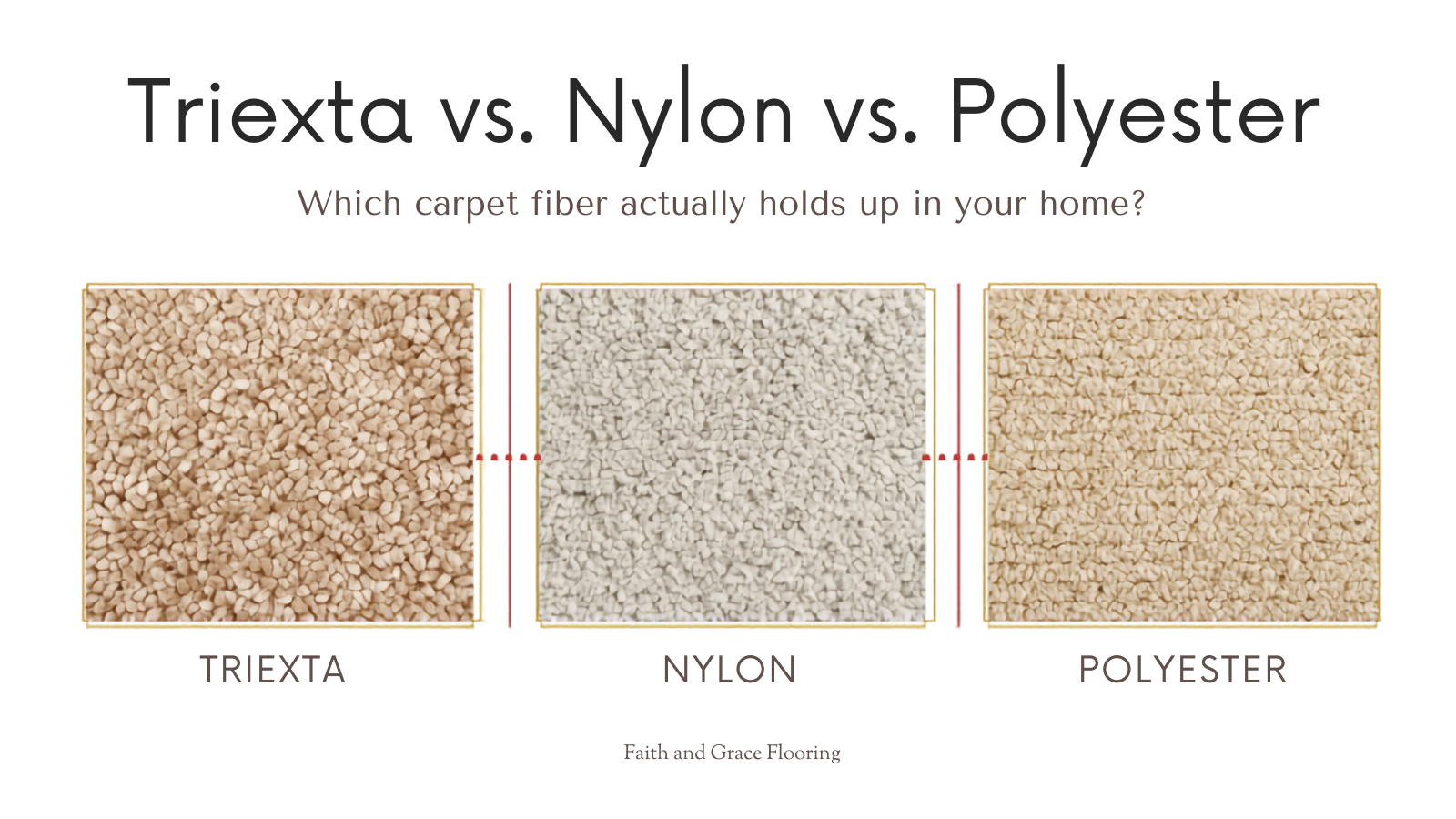
Two carpet samples look nearly identical on the rack. They feel about the same in your hand. One costs almost twice what the other does, and the only visible difference is a word on the back of the label: nylon, triexta, or polyester.
That word predicts a lot about how the carpet will look in your hallway three winters from now. Here is what each fiber actually does, where each one struggles, and how to check a sample yourself before you commit.
What the Fiber Name on the Label Really Tells You
Carpet fiber controls three things: how well the pile springs back after being walked on, how easily stains soak in, and how much you pay per square foot.
The pile is made of thousands of yarn tufts standing upright. Every step bends them over. A resilient fiber has a kind of memory and stands back up. A less resilient fiber gradually stays bent. Once enough tufts lie flat in the same direction, you get that worn path down the hallway that no amount of vacuuming fixes.
Stain behavior works differently. Some fibers repel liquid because of what they are made of. Others rely on a stain-resistant coating applied at the mill, which slowly wears away with traffic and cleaning.
Nylon: The Resilience Benchmark
Nylon has the best recovery of any carpet fiber sold in volume. Crush it, and it stands back up. That is why it dominates hallways, stairs, and any room where furniture gets moved around.
You will see two versions on labels. Nylon 6,6 has a tighter molecular structure than nylon 6 and is generally marketed as the more durable of the two. In a home, both perform well, and construction quality often matters more than which number is printed on the tag.
Nylon absorbs dye readily, which is why the color range is enormous. That same quality is why it needs stain protection applied at the factory. Ask whether the carpet is solution dyed, where color is added to the liquid polymer before the fiber is even formed. Solution-dyed nylon holds color against sunlight and even survives contact with diluted bleach, which matters in a basement or a laundry area.
The honest downside is price. Quality nylon usually sits at the top of the synthetic range, and cheap nylon built with low density gives up most of the advantage you paid for.
Triexta: Stain Resistance Built Into the Fiber
Triexta is the newest of the three, and it solves the stain problem from a different direction. Rather than coating the fiber, the fiber itself resists absorbing liquid. Spills sit on the surface longer, which gives you time to blot them up.
That advantage grows over the years rather than fading. A topical stain treatment thins out with vacuuming and cleaning. Built-in resistance does not wear off, because there is no coating to lose.
Triexta also has an environmental angle worth knowing about. Roughly a third of the polymer comes from a plant-based ingredient rather than petroleum, according to the manufacturer. If sustainability factors into your decision, it is a genuine point in triexta's favor, and it pairs well with the options in our eco-friendly carpet guide.
Where does triexta land on resilience? Somewhere between nylon and polyester, closer to nylon. It handles family traffic well. In the very heaviest wear areas, a dense nylon still has the edge on long-term recovery. You can read more about the fiber in our breakdown of triexta carpet benefits, or look at what we stock on the triexta carpet page.
Polyester: Softness and Color, With One Real Catch
Polyester gives you the softest hand feel and the clearest, richest colors for the money. Run your palm across a plush polyester sample and the difference is immediate.
It also resists water-based stains well. Kool-Aid, coffee, and juice tend to lift out without much drama.
The catch is oil. Polyester attracts oil-based soils, which is a bigger deal than it sounds. Body oils, cooking residue tracked in from the kitchen, and the film that comes off shoes all bind to the fiber and hold dirt in place. Over time that shows up as a dingy traffic lane rather than a spot you can point to.
Resilience is the other tradeoff. Polyester crushes sooner than nylon or triexta. In a guest bedroom or a formal sitting room that sees light use, that hardly matters and the value is excellent. In a main hallway, it shortens the life of the floor considerably.
Wool: The Natural Option
Wool has been used for carpet for centuries and still beats most synthetics on holding its appearance. The natural crimp in the fiber gives it real spring, and the scaled surface hides soil unusually well.
It is naturally flame resistant, it does not off-gas the way some synthetics can, and it feels like nothing else underfoot.
Wool costs considerably more, and it has genuine sensitivities. Bleach destroys it, some cleaning chemicals will damage it, and it needs the right care routine. Look after it properly and it will outlast almost anything. Treat it like a synthetic and you will damage it.
The Number That Predicts Matting Better Than the Fiber Does
Here is the part that gets skipped in most carpet conversations, and it will save you more trouble than picking the "right" fiber.
Density beats fiber type for predicting whether a carpet will mat. A dense polyester will outlast a thin, loosely tufted nylon in the same hallway. Density describes how tightly the tufts are packed together. Packed tightly, they hold each other upright. Spaced loosely, they fold over and stay there.
Two specs on the label get you there. Face weight is how many ounces of fiber sit in a square yard. Pile height is how tall the tufts stand. A high face weight spread over a tall pile is not dense, it is just tall. The same face weight in a shorter pile is packed and durable.
The other spec to look for is twist, the number of times each yarn is twisted per inch and then heat-set to hold that shape. Tighter twist means the tuft tip stays closed instead of blooming open and looking frayed. When you compare two samples of the same fiber and one looks fuzzy at the tips while the other looks crisp, you are looking at a twist difference.
If you want to see what happens when density runs out, our article on matted carpet and how to revive it shows the end result.
How to Test a Sample Before You Buy
Bring the samples home. Showroom lighting flatters everything, and the useful tests take ten seconds each.
The fold test
Fold the sample backward with the pile facing out, so the tufts spread apart. If the backing shows through easily, the carpet is low density and will mat sooner. If the tufts stay packed and you barely see the backing, you are holding a dense carpet.
The thumb test
Press your thumb into the pile hard, hold for a few seconds, then let go. A resilient carpet recovers almost immediately. If your thumbprint sits there, that is what your sofa leg will do.
Check it in your own light
Put the sample on the floor in the actual room, and look at it in the morning and again under lamps at night. Carpet color shifts more than most flooring, and our guide to choosing floor colors for Middle Tennessee lighting covers why that happens.
Matching the Fiber to the Room in Your Middle Tennessee Home
Most homes do better with different choices in different rooms than with one carpet everywhere.
Hallways, stairs, and family rooms take the most abuse. Dense nylon or dense triexta earns its keep here, and this is the wrong place to save money on a thin construction.
Bedrooms and guest rooms see far less traffic. Polyester makes real sense here, where the softness is what you notice daily and the crushing never gets a chance to happen.
Homes with pets lean toward triexta for the built-in stain resistance, or solution-dyed nylon if accidents are likely and you want to clean aggressively without losing color. Our pet-friendly flooring guide goes further on this.
Basements and lower levels in Rutherford and Williamson Counties deal with humidity that upstairs rooms never see. Synthetic fibers handle that better than wool, and it is worth checking the subfloor conditions before ordering anything.
What This Costs You in Practice
Ranked roughly from most to least expensive: wool, then quality nylon, then triexta, then polyester. The gaps narrow quickly once you compare similar densities, and a well-built triexta often lands close to a mid-grade nylon while outperforming it on stains.
The mistake worth avoiding is buying the best fiber in its cheapest construction. A thin nylon at a bargain price will disappoint you faster than a dense polyester at the same price, because density is doing more of the work than the fiber name suggests.
You can browse constructions and colors across all four fiber types in our carpet collection, or read the background on each type on our carpet information page.
Bringing It Together
Pick nylon when the room takes a beating and you want the pile to keep standing up. Pick triexta when spills are the daily reality and you want stain resistance that does not wear off. Pick polyester when softness and color matter most and the traffic is light. Pick wool when you want a natural fiber and you are prepared to care for it properly.
Then check density before you sign anything, because that is the spec that decides whether you love the floor in year five.
Our team at Faith and Grace Flooring works with these fibers every week across Murfreesboro and Nolensville. Come in and we will pull samples side by side so you can run the fold test yourself.
Visit us at 902 Dashiel St in Murfreesboro or 7305 Nolensville Rd in Nolensville. You can also read our customer reviews or ask about financing while you shop.
When you are ready to measure the rooms and price it out, book a free in-home flooring estimate and we will bring the samples to you.