

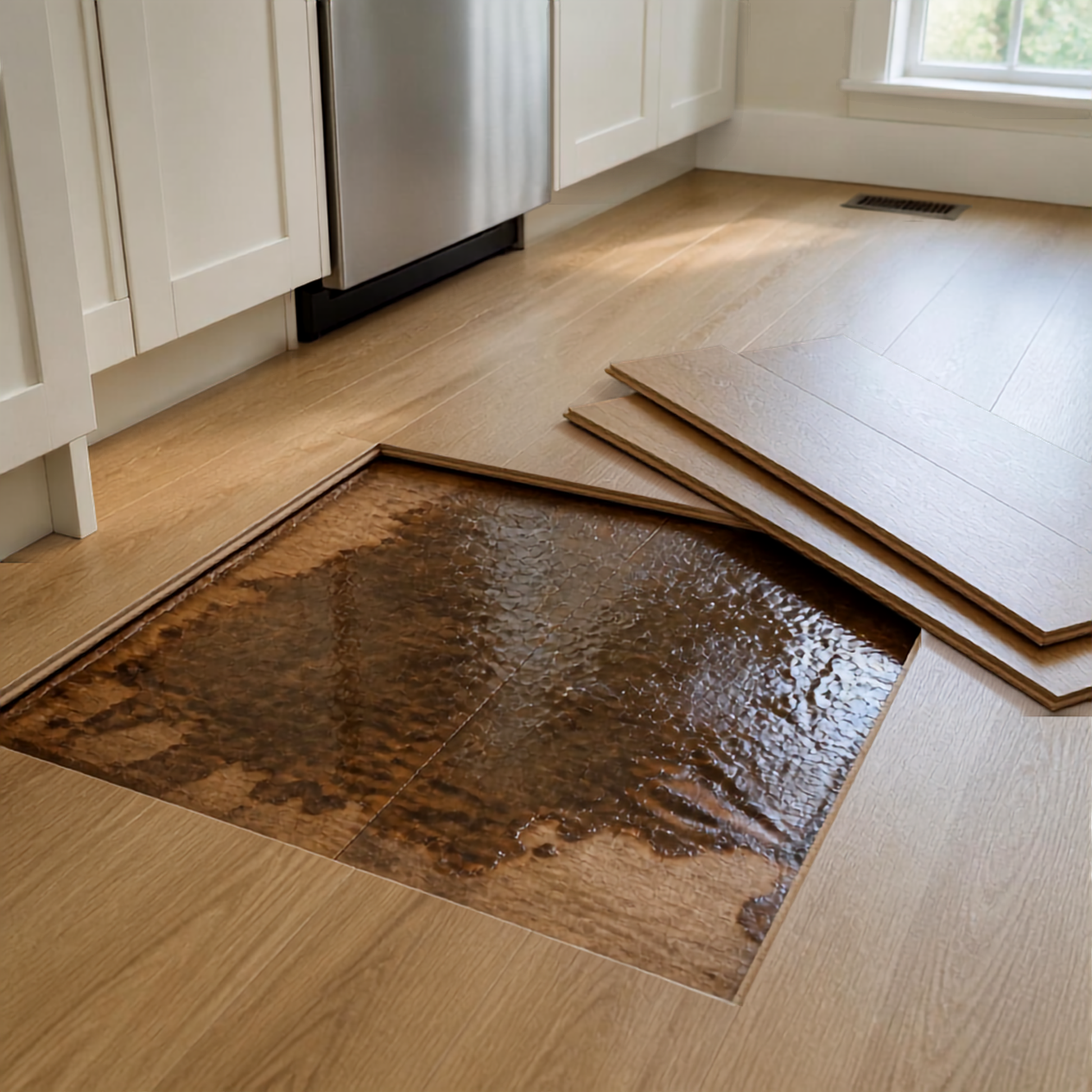
The dishwasher line let go sometime Friday night. Saturday morning there was a shallow puddle in front of the sink, and you mopped it up in about ninety seconds. The vinyl looked perfect — not a mark on it, not a swollen edge, nothing.
Three weeks later the room smells a little sour, two planks near the cabinet have a gray shadow under them, and there is a spot by the island that gives slightly when you step on it.
Your floor did exactly what it promised. Vinyl plank is waterproof. The catch is that waterproof describes the plank — not everything underneath it.
The plank will be fine. What is under it probably will not be.
Water slips through the seams and sits on your subfloor, where the vinyl above it stops any of it evaporating. Within 24 to 48 hours, mold can start. Within a week, a wood subfloor swells and softens.
Speed decides everything. Water found and dried in the first day usually leaves no trace. The same water left for a week means the floor has to come up. If you know water got under there, open it up — do not wait to see if it dries, because it cannot.
Your Floor Is Waterproof. The Wood Under It Isn’t.
A modern vinyl plank is essentially solid. You could leave one in a bucket of water for a month and it would come out unchanged — no swelling, no warping, no rot. That is a real advantage, and it is why luxury vinyl flooring has taken over kitchens, bathrooms, laundry rooms and basements across Middle Tennessee.
But a finished floor is a stack, and the plank is only the top of it. Underneath sits a thin foam pad, then the subfloor — usually plywood or a chipboard-style panel called OSB — then the framing that holds up your house. Everything below the plank can be damaged by water.
And the joints between planks are water resistant, not watertight. Standing water finds them. So does water running down the back of a cabinet, seeping from a toilet, or creeping in along the gap that every floating floor leaves hidden behind the baseboard.
Once water is under there, the plank that protected your floor from the spill now protects the spill from the air. It cannot evaporate. So it sits, it spreads, and it goes to work.
What Happens Under the Plank, Hour by HourDrag the slider
A slice through a typical vinyl floor after water gets past the seams. Drag the timeline and watch the damage develop.
Water enters at a seam or the gap behind the baseboard, then spreads sideways under the floor.
Hour 0 — the spill happens
Water is still on top of the floor. Catch it here, dry the surface, and none of the rest of this timeline happens. This is the whole reason speed matters so much with vinyl plank.
Hours 1–5 — water finds the seams
Standing water works its way through the joints between planks and the gap behind the baseboards. It reaches the pad and starts moving sideways. Nothing shows on top yet, which is exactly the problem.
Hours 6–23 — it spreads further than you think
A floating floor is one big connected sheet, so water travels well past the original spill — often several feet in every direction. The wood subfloor starts soaking it up, and wood swells as it does.
Day 1 to 2 — mold becomes possible
This is the threshold that matters most. The EPA says mold can start growing on damp material within 24 to 48 hours. Under a sealed vinyl floor the conditions are close to perfect for it: wood to feed on, moisture, no air movement, comfortable temperature.
Day 2 to 7 — swelling, smell and movement
The subfloor panels swell along their edges, creating ridges you can feel through the floor and lifted plank edges above them. A musty smell reaches the room. Screws and nails lose their grip in softened wood, which is where squeaks and soft spots begin.
Week 2 and beyond — real damage
The subfloor starts coming apart in layers and loses strength, and mold takes hold underneath. At this point the vinyl has to come up whatever condition it is in, part of the subfloor is usually replaced, and mold cleanup becomes a separate job.
These timings are typical, not guaranteed. Warm, humid conditions speed everything up. A little clean water on a concrete slab moves much slower.
How Water Sneaks Under a Vinyl Floor
Almost nobody floods their kitchen. The problems we see in Murfreesboro and Nolensville homes are usually slow, small and hidden.
- Appliance hoses. Dishwashers, ice makers and washing machines leak from the back, where nobody looks, and the water runs under the cabinet before it ever reaches open floor.
- Toilets. A failing seal releases a little water with every flush, right at the most vulnerable seam in the room.
- Showers and tubs. When the caulk along the tub fails, water goes behind the edge of the floor instead of onto it.
- Water heaters. Usually a slow drip long before it is a burst tank, and usually in a closet nobody checks.
- Air conditioning. A blocked drain line on a humid Rutherford County summer day can deliver gallons over a week without a sound.
- Weather and the ground. Rain at a door threshold, or a lower-level floor where moisture comes up through the concrete. Our guides to storm damage and seasonal floor care in our humid climate cover both.
- Mopping with too much water. Not one big event, but hundreds of small ones. A soaking mop pushes a little water into every seam it crosses, every week, for years.
Notice the pattern: almost every one of those delivers water to the edge of the room or underneath a fixture. Those are the two places your floor is least protected and where you are least likely to spot it.
How Do I Know If There Is Water Under There?
Early on, you often cannot see anything at all. Later, your floor gives you several clues at once. Tick off anything you have actually noticed below.
Symptom CheckTap all that apply
Each sign is weighted by how strongly it points to trapped water rather than something harmless.
Nothing selected yet
Tap any signs you have actually noticed. And if you know water got under the floor but see none of these, that is still worth acting on — the early stages are invisible from above, which is exactly why this gets expensive.
Low signal — keep an eye on it
One mild sign can have an innocent explanation: a plank that never fully clicked in, a high spot in the subfloor from the original build, or a seam that settled. Look for a water source, watch it for a couple of weeks, and note whether it changes with the weather or after you run appliances.
Moderate signal — worth investigating now
This combination usually means water really is under there, rather than a cosmetic installation issue. Find and stop the source first, then have a plank lifted at the edge of the affected area so someone can actually see and test the subfloor. Guessing gets expensive from here.
Strong signal — assume damage is happening
Smell plus softness plus visible movement is the classic signature of a wet, deteriorating subfloor with mold underway. This is not a wait-and-see situation. Stop the water, open the floor over the affected area, and get the subfloor dried and assessed before deciding what can be saved.
The 48-Hour Rule
If you remember one thing from this article, make it this: the outcome depends on how fast the water comes out, not on how much water there was.
A gallon of clean water dried within a few hours usually leaves no trace at all. A cup of clean water left under a plank for a week leaves swollen subfloor, a smell, and mold.
The EPA is blunt about the window: mold can begin growing on damp material within 24 to 48 hours. Under a vinyl floor that clock runs faster than in an open room, because the one thing that would normally save you — evaporation — is precisely what the floor prevents.
If you know water got under your floor: stop the source, then open the floor. A floating floor can usually be unclicked from the nearest wall and put back down afterwards, which makes acting early far cheaper than most people expect. Waiting to “see if it dries” under a waterproof plank is waiting for something that cannot happen.
Is My Floor Floating or Glued Down?
This one detail changes how far the water spreads, how much of the floor has to come up, and whether your planks can be reused. Most homeowners have no idea which type they have — and you can usually work it out in about a minute.
Which Kind of Vinyl Floor Do I Have?3 quick checks
Answer what you can. “Not sure” is a perfectly good answer — the result adjusts.
1. Does the floor give slightly or feel a bit springy underfoot?
2. Is there a small gap at the wall, hidden behind the baseboard or under a floor vent?
3. Did the installers snap planks together by hand, with no buckets of adhesive?
Sounds like a glued-down floor
Good news: glue fills most of the space under the planks, so water spreads more slowly and stays closer to where it started. The wet area is usually smaller.
Bad news: moisture attacks the glue itself. The bond softens and planks lift, shift or bubble up. Taking them up is destructive — glued planks rarely survive removal — so a repair here normally means replacing the flooring in the affected area.
Not enough to tell yet
Answer a couple of the questions above and this will narrow down. If you would rather check for certain: pull off a heating vent cover or a section of baseboard shoe and look at the edge of the floor. A floating floor leaves a deliberate gap at the wall — usually about a quarter of an inch — so the floor can expand. A glued floor runs right up to the wall.
Most vinyl plank installed in homes over the last decade or so is the floating, click-together kind.
Sounds like a floating floor
Bad news: the whole floor is one connected sheet resting on the subfloor, so water entering at one seam can travel several feet. Damage often turns up well away from the leak.
Good news, and it is significant: planks can usually be unclicked from the nearest wall, the subfloor dried and repaired, and the same planks laid back down. That makes early action dramatically cheaper than it would be with a glued floor.
What to Do in the First Day
If you have found water under a vinyl floor, this order gives you the best outcome.
- Stop the water. Shut the valve, unplug the appliance, or turn off the main. Everything else is pointless while water is still arriving.
- Dry the surface. Wet vacuum, towels, fans. This limits how much more gets underneath.
- Find the edges. Press across the floor with your palm or heel to find soft or moving areas. Mark the boundary with painter’s tape — the wet area is almost always bigger than what you can see.
- Open the floor. On a floating floor, take off the shoe moulding and unclick planks from the nearest wall toward the wet zone. On a glued floor, planks over the wet area get cut out. Air cannot dry what it cannot reach.
- Dry it properly, then check. Fans plus a dehumidifier, running continuously. Do not go by how the subfloor looks — a moisture meter reading is the only way to know it is genuinely dry before anything goes back down.
- Decide what stays. Clean, undamaged planks can usually be reinstalled. Swollen or contaminated subfloor gets cut out and replaced. Anything that looks like mold is a cleanup job in its own right.
- Fix the cause before you close it up. A new floor over an unrepaired leak is a new floor with a countdown on it, and how the replacement goes in decides how it handles the next one.
How Much of the Floor Has to Come Up?
More than you would expect, and this catches people by surprise. Because water spreads sideways under a floating floor, the standard practice is to open the floor about two feet past the visible damage in every direction. Here is what that actually means in square feet.
Wet Area vs. What Has to Be OpenedDrag the sliders
Set the size of the area that looks wet. The dashed outline shows how much floor actually needs to come up.
Plank count assumes a common 7 by 48 inch plank. On a floating floor you also have to lift every plank between the wet zone and the nearest wall to get there, so the real number is often higher. This is the moment those leftover boxes in the garage earn their keep.
Can It Be Saved, or Does It Have to Go?
Honestly, it comes down to three things: how long the water sat, what your subfloor is made of, and how clean the water was.
| What happened | Likely outcome | What usually gets replaced |
|---|---|---|
| Clean water, found and dried within a day | Full recovery is realistic | Usually nothing — open it, dry it, check it, put it back |
| Clean water, a few days, plywood subfloor | Often saved with proper drying | The foam pad; sometimes a small patch of subfloor |
| Clean water, a few days, OSB subfloor | Swollen edges usually stay swollen | The affected subfloor panels |
| Any water left more than about two weeks | Assume mold is present | Pad and affected subfloor, plus a cleanup assessment |
| Dishwasher or washing machine water | Not clean water — contamination from the start | Pad and affected subfloor, plus sanitising |
| Sewage or flood water | Not a do-it-yourself job | Flooring and anything absorbent; call a restoration company |
| Glued-down floor where planks have lifted | Planks rarely survive removal | The flooring in the affected area |
Scroll the table sideways on a phone to see all three columns.
OSB is the chipboard-looking panel used in most newer construction. Its wood strands swell when they get wet and largely stay swollen after drying, so the panel edges rise into a permanent ridge you can feel through the floor. Plywood handles a soaking better, as long as it dries quickly.
Two things push a job from repair toward replacement more than anything else: time, and whether the planks survive coming up. That second one is a genuine argument for floating floors in rooms where water is a realistic possibility — laundry rooms, kitchens, mudrooms and lower levels. It is worth raising early in any kitchen or bath remodel.
Not sure whether your floor can be saved? We can look at the affected area, check the subfloor, and tell you plainly what needs to happen — at either our Murfreesboro or Nolensville showroom.
See our flooring services →Stopping It Happening Again in Middle Tennessee Homes
You cannot make a floor immune to plumbing. You can make water far less likely to get under it, and far more likely to be caught early.
- Seal the edges in wet rooms. In bathrooms and laundry rooms, a bead of silicone in the gap behind the shoe moulding blocks the most common way in without stopping the floor moving.
- Caulk around toilets, tubs and shower curbs. These are the seams that fail quietly for years.
- Consider glue-down in small wet rooms. In a powder room or laundry closet, adhesive slows the spread and keeps a leak near its source.
- Put a drip pan under the water heater and washing machine.
- Add water alarms. Inexpensive sensors behind the dishwasher, under sinks, by the water heater and beside the washer catch exactly the failures that cause the most vinyl plank damage.
- Damp mop, never wet mop. A barely damp microfibre mop cleans vinyl completely. A sopping mop pushes water into every seam, week after week.
- Check the air conditioning drain line each spring, before our humid season gets going.
- Keep two or three spare boxes of planks. They turn a future repair into a same-week fix with a perfect colour match.
Where moisture is a constant rather than an accident — a basement, a slab floor, or anywhere with a history of humidity problems — the product matters as much as the maintenance. Our waterproof luxury vinyl collection is where most Murfreesboro and Nolensville homeowners start, and tile flooring remains the most water-indifferent option we carry. For utility spaces, our waterproof sheet and tile vinyl is worth a look too. And if anyone in the house manages allergies or asthma, our guide to flooring for allergy relief is relevant — trapped moisture and indoor air quality are closely linked.
Vinyl Plank and Water: Frequently Asked Questions
Will water ruin vinyl plank flooring?
Not the plank itself. Modern vinyl plank is waterproof and does not swell, rot or come apart. What water ruins is everything underneath: the foam pad, the wood subfloor, and with longer exposure the framing. In most cases the planks survive and the subfloor does not.
How long can water sit under vinyl plank before it causes damage?
The critical window is roughly 24 to 48 hours. The EPA notes mold can start growing on damp material in that time, and the sealed, airless space under a vinyl floor is close to ideal for it. Water caught and dried within the first day usually leaves no lasting damage. Water left for a week reliably causes swelling and smell.
Can mold grow under vinyl plank flooring?
Yes. Mold needs moisture, something organic to feed on, and still air. A wet wood subfloor under a waterproof plank provides all three. The vinyl is not the food source — the wood beneath it is. A musty smell with no visible cause is usually the first sign, and it is worth investigating rather than covering up.
How do I know if there is water under my vinyl floor?
Look for a musty smell that keeps returning, soft or spongy areas underfoot, dark shadows through the plank surface, lifted seams or a ridge across the room, and damp at the baseboard or doorway strip. The symptom checker earlier in this article weighs these together. To be certain, a plank is lifted at the edge of the suspect area and the subfloor checked with a moisture meter.
Can I dry a wet subfloor without taking up the planks?
Realistically, no. The plank and its attached pad form a sealed lid, and drying needs air moving across the wet surface. Fans blowing over the top of the floor do nothing for the water underneath it. On a floating floor, unclicking planks from the nearest wall is straightforward and reversible — and it is the step that actually solves the problem.
Does water get under vinyl plank from a concrete slab?
It can, but as damp air rather than a puddle. Concrete slabs continuously move moisture upward, and if it is more than the floor is rated for you can end up with condensation, smell and glue failure with no leak at all. That is a different problem with a different fix, and it is worth testing the slab before installing over concrete. Our flooring FAQ covers more of the questions that come up on slab installations.
Should I replace the whole floor or just the damaged section?
For a floating floor, a section repair is often possible if you kept spare planks or the product is still available — though colour and finish can shift slightly between production runs. For a glued floor, planks rarely survive removal, so the affected area is replaced and blending becomes the challenge. In open-plan spaces the visual break usually decides it: with no natural transition point, replacing the run often looks better than patching it.
Is laminate or vinyl safer where water is a risk?
Vinyl, clearly. Laminate has a wood-based core that swells and stays swollen once wet, so the plank itself is damaged along with the subfloor. Vinyl’s waterproof core means only the subfloor is at risk. In kitchens, bathrooms, laundry rooms and basements, vinyl or tile is the more forgiving choice. A related warning sign in laminate is a hollow, drum-like sound underfoot.
The Bottom Line
Water under vinyl plank is not really a flooring problem. It is a hidden moisture problem wearing a flooring disguise — and it is one of the few things in a house where the gap between a minor annoyance and a major expense comes down almost entirely to how fast you act.
The plank will be fine. What is underneath it will not be, unless air reaches it within a day or two.
So if you know water got to your floor, open it up and dry it. If you only suspect it, find out for certain instead of waiting for the smell to answer the question. And if you are choosing new floors for a room where water is a live possibility, say so — the right product, the right installation and the right edge detail turn the next leak into a story rather than a project. Soft spots and squeaks that appear later are worth checking too; our guide on when soft spots mean it is time to replace your floors explains what to look for.
Faith and Grace Flooring serves homeowners across Murfreesboro, TN and Nolensville, TN, with showrooms at 902 Dashiel St in Murfreesboro and 7305 Nolensville Rd in Nolensville. We install vinyl and luxury vinyl throughout Rutherford and Williamson Counties, and we are happy to look at a floor that is behaving strangely before it becomes an emergency. Read what our customers say, browse our full range, or ask about financing on a larger repair.
Worried about what is under your floor?
Book a free, no-obligation in-home estimate with a Faith and Grace Flooring specialist in Murfreesboro or Nolensville — and get a straight answer about what needs to happen next.
Request Your Free Estimate →