

You just paid for beautiful new floors. A year later the edges near the back wall are curling, there is a gray shadow under two planks, and the room smells faintly like a basement. Nobody spilled anything. Nobody dragged furniture across it. So what happened?
In a home built on a concrete slab, the answer is usually sitting underneath the floor the whole time: moisture coming up out of the concrete.
This guide explains what that means in plain English. How to check your own slab for free this weekend, what your installer’s test result is actually telling you, and which floors hold up best when a slab is damp. No engineering degree required.
Yes, moisture in a concrete slab can ruin new flooring — and it is one of the most common reasons floors fail in slab-built homes.
Concrete holds water you cannot see or feel. Cover it with flooring and that moisture gets trapped, where it goes after the glue, the padding, and any wood in the floor. The fix is refreshingly simple: test the slab before you buy anything. A moisture test costs a tiny fraction of replacing a failed floor, and it tells you exactly which floors will last in your home.
Why Concrete Is Basically a Very Dense Sponge
Concrete looks like the most solid thing in your house. Up close it is full of microscopic channels — picture a sponge squeezed almost flat. Those channels hold water, and they let water travel.
Your slab picks up moisture from two places.
The water it was mixed with. Concrete is poured wet on purpose so it can be spread and smoothed. Far more water goes in than the concrete needs to harden, and the leftover has to slowly evaporate out. That takes months, not days.
The ground underneath. This one never stops. Middle Tennessee soil holds water well, especially after our spring storms, and it wicks up into the slab the way a paper towel pulls up a spill. That is why a slab poured in 1985 can still test wet today.
Here is the part that catches people out: a slab can feel bone dry on top and still be damp inside. The top half-inch dries quickly. The middle can stay wet for a very long time. Touching it tells you nothing.
What Is Actually Under Your Floor?Tap a layer
A slice through a typical slab home in Murfreesboro or Nolensville, from your floor down to the dirt. Tap any layer to see what it does and how it lets you down.
The blue arrows are moisture. It only ever travels one direction: up, toward your floor.
1. Your floor
Vinyl, wood, laminate, tile or carpet. The second it goes down it acts like a lid on a pot. Moisture that used to quietly evaporate into your living room now has nowhere to go, so it collects underneath. Choosing a floor that can live with that is what this whole article is about.
2. Glue or padding
This thin layer is almost always the first thing to fail. Flooring glue is water-based, and damp concrete softens it from below until it lets go — planks shift, seams open, tiles lift at the corners. Floors that float instead of being glued skip this problem completely, which is why they handle damp slabs so much better.
3. The concrete slab
Usually about 4 inches thick in a Middle Tennessee home. It holds leftover water from the day it was poured and keeps drinking from the ground below. This is the layer that gets tested — and the reading comes from a hole drilled a couple of inches down, not from the surface.
4. Plastic sheet (the moisture barrier)
A heavy sheet of plastic laid on the ground before the concrete was poured. When it is there and undamaged it blocks most ground moisture. When it was skipped — common in older homes — or torn during construction, the slab never really gets to dry out. You cannot see it or fix it now, but knowing whether your home is old enough to be missing one is genuinely useful.
5. Gravel
A few inches of clean stone. Its job is to break the wicking action: water climbs through packed soil the way it climbs a paper towel, but it cannot climb through the big gaps between stones. Without it, the slab is essentially sipping from the ground.
6. The ground
Our soil holds water, and a wet spring can keep it saturated for weeks. Gutters that dump next to the foundation, ground that slopes toward the house, or a sprinkler aimed at the wall will all keep the ground — and therefore the slab — permanently damp.
The Free Test You Can Do This Weekend
Before you call anyone, you can get a useful first answer yourself for about three dollars. All you need is a piece of clear plastic sheeting and some strong tape.
It will not give you a number, and it does not replace a real test. But if it comes back wet, you have learned something important before spending a cent on flooring.
The Plastic Sheet TestDo it yourself
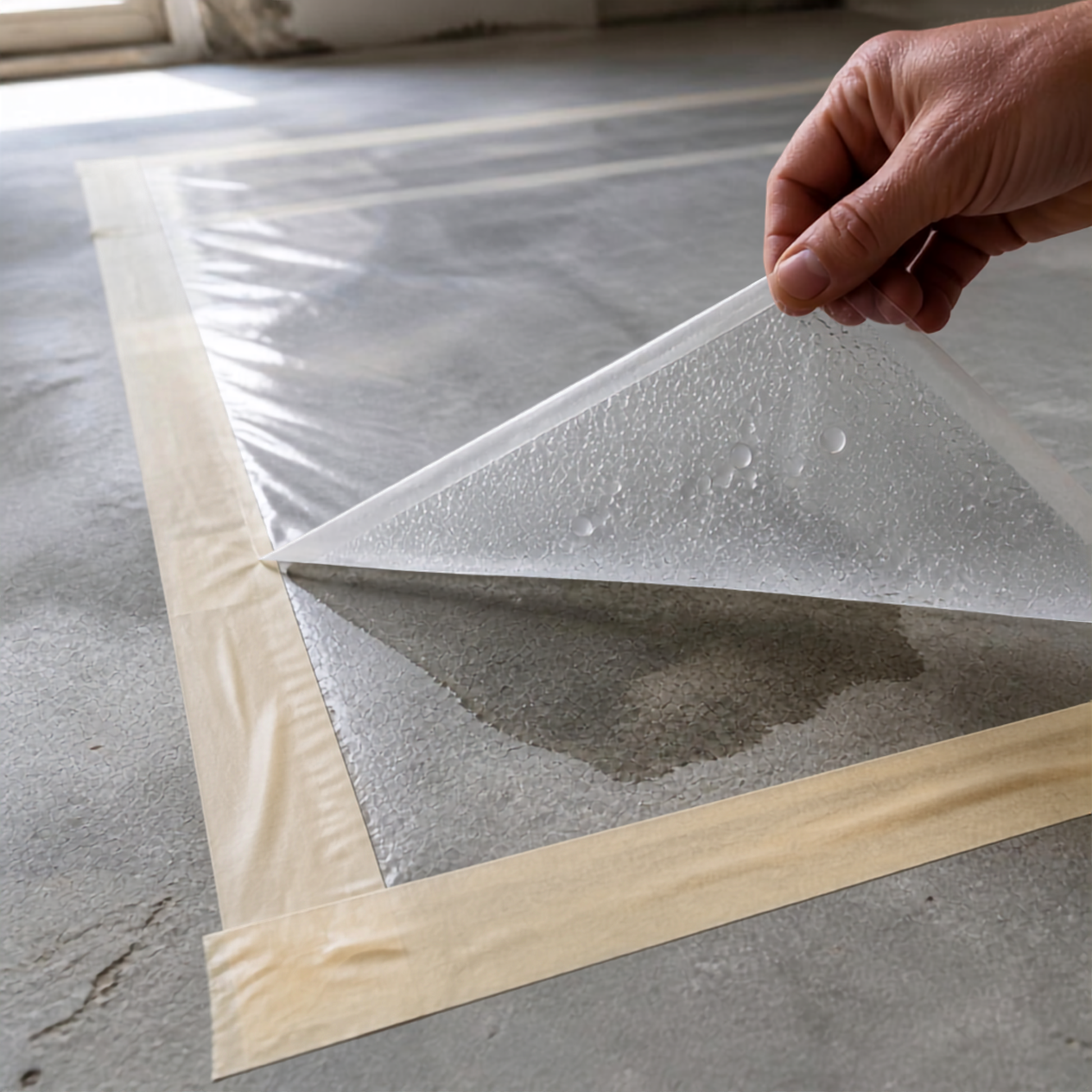
Tape a square of clear plastic to bare concrete, wait a day, and look underneath. Here is exactly what you are looking for.
Left: plastic still clear, concrete the same shade as the rest of the floor. Right: water droplets clinging underneath and a dark patch on the concrete — moisture is moving.
What you need
A square of clear plastic sheeting roughly 18 by 18 inches — a cut-up painter’s drop cloth works fine. Strong tape that seals well, such as duct tape. And bare concrete to test on, so you will need a spot where old flooring is already up: a closet, a utility room, or the edge of the garage.
How to do it
Sweep the spot clean and let it dry. Tape all four edges of the plastic down tight so no air can sneak in — a loose edge ruins the test. Leave it alone for 16 to 24 hours with the room at normal temperature. Do a few squares in different places if you can: near an outside wall, in the middle of the room, and anywhere you have ever seen a damp mark.
Reading the result
Peel back a corner and look. Beads of water on the underside of the plastic, or concrete that has gone noticeably darker than the floor around it, means moisture is actively coming up. Clear plastic and matching concrete color is a good sign.
One caution: on a hot day a cold slab can sweat for reasons that have nothing to do with ground moisture. Run the test when indoor and outdoor temperatures are reasonably close.
What it cannot tell you
This test only sees the very top of your slab. It can pass a slab that is still too wet deeper down — which is exactly the moisture that causes trouble once you seal the floor. So a wet result is meaningful, but a clear result is not a green light. Treat it as a free early warning, not a clean bill of health.
The Real Test, and What Your Number Means
The proper test is quick and inexpensive. A technician drills a small hole into the slab, drops in a sensor, seals it, and comes back the next day to read it. The sensor measures the humidity inside your concrete — think of it as a weather report from within your floor.
You get back a single number: a percentage. That is it.
That is just the industry rulebook for doing the humidity test properly — how deep the hole goes, how long to wait, how many spots to check. Seeing it on a quote is a good sign. It means someone is testing to a real standard rather than eyeballing it.
Some reports give you pounds instead of a percentage. That is an older test measuring how much moisture comes out of a 1,000-square-foot area in a day. It answers the same question in different units, and the slider below handles both.
What Does My Number Actually Mean?Move the slider
Slide to the reading on your report and see what it means for your floor choice, in plain terms.
Green light — pick whatever you love
Your slab is inside the traditional safe line that nearly every flooring brand uses. Practically anything in our showrooms is on the table, including glued-down floors, which are the fussiest about moisture.
Yellow light — the product you pick starts to matter
You are past the old-fashioned safe line, but plenty of modern floors and glues are approved for this range. Nothing here is alarming. It just means the key question at the showroom shifts from “do I like this?” to “is this one rated for my slab?”
Orange light — you need a plan, not just a product
At this level you want either a floor specifically approved for it, or a moisture barrier applied to the slab first. Installing a standard glued-down floor on a slab reading this high is how floors come loose within a year or two.
Red light — treat the slab before you floor it
Your slab is close to soaking wet. A moisture barrier coating should go down before any flooring does, and it is worth finding out where the water is coming from. Gutters, grading and drainage are often the real culprit.
A guide, not a guarantee. Every brand sets its own limit and the glue used can shift it either way, so always check the product you actually choose.
Why Glue Is Almost Always the Weak Link
Here is the most useful thing to understand about slab moisture, and it fits in one sentence: the flooring usually is not what fails. The glue is.
A vinyl plank could sit in a bucket of water for a month and come out unchanged. But the glue holding it to your concrete is water-based, and damp concrete softens it from underneath until the bond gives up. Then planks slide, seams open and edges lift.
Which explains why floating floors handle damp slabs so much better. A floating floor is not attached to the concrete at all — the planks lock to each other and rest on top, usually over a thin plastic sheet. No glue, no bond to break. That is the main reason luxury vinyl flooring has become the default recommendation for slab homes across Murfreesboro and Nolensville.
Worth knowing: moisture rarely destroys glue on its own. As water rises through concrete it picks up minerals and turns alkaline — chemically not far from bleach. That is what actually eats the glue. A pH test takes about a minute and costs almost nothing, so ask for it alongside the moisture test.
So Which Floor Should You Choose for a Middle Tennessee Slab Home?
That depends on three things: where the room is, how wet it gets, and whether you are already seeing signs of dampness. Answer those below and you will have a shortlist to walk into the showroom with.
Which Floors Suit My Concrete?3 quick questions
Tap one answer in each row. The recommendation updates as you go.
1. Where is this room?
2. How often does this room get wet?
3. Any signs of dampness already?
Low risk — you have plenty of choice
Good options: luxury vinyl, tile, laminate over a plastic barrier, engineered hardwood, or carpet.
The one to skip: solid hardwood, if this floor sits on a slab. Solid planks move too much over concrete. Engineered wood exists to solve exactly that, and looks the same underfoot.
Moderate risk — lean toward water-friendly floors
Best bets: waterproof vinyl plank that clicks together, or tile. Both shrug off the kind of moisture this room is likely to see.
Possible with care: laminate, provided a plastic barrier goes down and the slab tests in range.
Think twice about: glued-down wood, solid hardwood, and wall-to-wall carpet in the wetter spots.
Higher risk — get the slab tested before you shop
Between the location and what you are already noticing, this room deserves a moisture test first. Choosing flooring before you know the number is guessing with your own money.
Most likely to work: tile, or waterproof floating vinyl over a barrier. If the test comes back high, a moisture barrier coating on the slab opens those options back up with a warranty behind them.
Also worth checking: where the water is coming from. Gutters and grading fix more “flooring problems” than flooring does.
Not sure what your slab reads? We check moisture as part of the estimate on slab installations in Murfreesboro and Nolensville — before anything gets ordered.
See how our free in-home estimates work →Upstairs, Main Floor or Basement? It Changes Everything
Flooring boxes often list where a product can be installed. Here is what those labels mean without the jargon.
Upstairs (the box may say “above grade”). The floor sits above the dirt line, usually over a wood subfloor. Ground moisture is barely a factor. Almost anything works here, including solid hardwood.
Main floor on a slab (“on grade”). Your floor is level with the soil outside. This describes most newer construction in Murfreesboro and Nolensville. Moisture pushes up constantly, and solid hardwood is generally off the table.
Basement or lower level (“below grade”). Soil presses against the walls and under the floor, so moisture arrives from every direction — sometimes as actual water, not just damp air. This is where waterproof vinyl, tile and epoxy flooring genuinely earn their reputation.
Building or Buying New in Murfreesboro? Ask When the Slab Was Poured
Middle Tennessee has been building fast, and that creates a very common problem: floors going down on concrete that has not finished drying.
The rule builders use is about one month of drying for every inch of thickness, and only when the house is closed up with heating or air conditioning running. A typical 4-inch slab therefore wants roughly four months. Poured in February with floors going in during April? That slab is not ready, no matter how dry the top feels.
Has My New Slab Had Enough Time?Rough guide
Based on a standard 4-inch home slab. A planning tool, not a replacement for a test — but it will tell you quickly whether your schedule is realistic.
Almost certainly too soon
A slab this young is very likely still releasing moisture. If floors are scheduled now, ask for a moisture test in writing before installation — and ask what happens to your warranty if the reading comes back high.
Getting there — test before you commit
You are in the range where the answer could genuinely go either way. This is exactly the situation a moisture test is for. It is inexpensive, it takes a day, and it turns a coin flip into a decision.
Past the guideline — still worth a quick test
Enough time has passed that the slab has a good chance of testing in range. Do not skip the test on that basis, though: concrete mixes vary and a wet spring slows everything down. You are simply far more likely to get a green light.
If the schedule and the slab disagree, you have three honest choices: wait, apply a moisture barrier, or pick a floor rated for the moisture you actually have. Our pre-installation checklist covers the rest of what to settle before install day.
What If the Test Comes Back High?
A high number is not a disaster. It just changes which projects make sense. You have four real options.
1. Wait
Free, and it works — if the slab is simply young and the house is heated or cooled. Running the AC and a dehumidifier genuinely speeds it up. Throwing the windows open on a muggy August day in Murfreesboro does not.
2. Seal the slab
A liquid moisture barrier is rolled onto the prepared concrete and forms a membrane that holds the moisture back. It adds cost and a day or two to the schedule, but it turns a problem slab into a normal one and comes with a warranty. For a high reading under a glued-down floor, this is usually the right call.
3. Choose a floating floor instead
The most economical reliable fix. Clicking planks over a plastic sheet removes glue from the equation and puts a barrier between concrete and floor. Browse the waterproof luxury vinyl collection to see what that looks like.
4. Go with tile
Tile is set in cement-based mortar, so it is perfectly at home with moisture. Porcelain does not swell, does not come apart, and does not feed mold. For a genuinely wet basement slab, tile is the most bulletproof answer there is.
Warning Signs Your Slab Is Already Causing Trouble
If you have floors down now and something feels off, these are the signs that point at the slab rather than the flooring:
- A musty, basement-like smell that keeps returning after cleaning
- Dark or cloudy shadows appearing under vinyl or laminate
- Planks lifting, sliding or gapping when nothing was dropped or spilled
- Wood flooring cupping — the edges of each board sitting higher than the middle
- Tiles sounding hollow, or grout crumbling in one area
- Carpet seams coming apart, or a damp feel near an outside wall
- White chalky powder on bare concrete where flooring has been lifted
Any of these are worth looking into before they spread. Our guide to squeaks and soft spots covers how to tell a nuisance from a real warning.
Five Questions to Ask Your Flooring Company
You do not need to understand concrete chemistry. You need five straight answers.
- Will you test my slab, and how? “An in-slab humidity test to ASTM F2170” is a real answer. “We’ll take a look” is not.
- How many spots will you check? One reading in the middle of a big open-plan room is not enough. Outside walls and areas near plumbing matter too.
- What is the moisture limit for the exact floor I picked? Not the category — the specific product, and the glue that goes with it.
- What happens if the slab tests too high? You want a plan and a price range agreed beforehand, not a surprise on installation day.
- Is the moisture protection warranted in writing? Barrier products carry manufacturer warranties. Ask whose warranty covers what.
A company that welcomes those questions has been doing this a while. You can see how our customers describe the process in our customer reviews, or read more about who we are.
Frequently Asked Questions About Concrete Slab Moisture
What is a safe moisture level for a concrete slab?
The traditional safe line is 75% humidity measured inside the slab, or 3 pounds per 1,000 square feet per day if your report uses the older pounds test. Plenty of modern floors and glues are approved up to 85% or even 90%. The only number that governs your job is the one printed in the instructions for the product you actually chose.
How long does new concrete need to dry before flooring?
Roughly one month per inch of thickness when the house is closed up and heated or air conditioned — about four months for a typical 4-inch home slab. A slab left open to the weather takes considerably longer. Because concrete mixes and weather vary so much, treat the calendar as a scheduling guide and let the moisture test make the decision.
Can I put vinyl plank flooring on a damp concrete slab?
Floating vinyl plank over a plastic barrier handles more slab moisture than almost anything else, and it is frequently the right answer for main floors and basements in Murfreesboro and Nolensville homes. Just remember that “waterproof” describes the plank, not everything under it — moisture trapped between concrete and vinyl can still cause odor and mold. Check the brand’s stated limit rather than assuming waterproof means unlimited.
Does a plastic barrier under laminate fix a wet slab?
A plastic barrier is required under laminate on any slab, and it handles normal moisture well. It will not rescue a slab reading far above the manufacturer’s limit, because laminate has a wood-based core that swells once moisture reaches it. In our humid summers, laminate over a borderline slab is a common cause of peaked seams — see our guide to laminate that beats Tennessee humidity.
Is carpet safe over a damp slab?
Less safe than most people expect. Glued-down carpet uses the same moisture-sensitive glue as other floors, and carpet plus padding over a damp slab creates a warm, humid layer where odor and mold develop. Where moisture is a known factor, a hard surface with a barrier is the more durable choice.
My floors are years old and only failing now. Why?
Slab moisture builds up and shifts with the seasons. A slab can sit just inside tolerance for years, then tip over the edge after a wet spring, a drainage change next door, or landscaping that redirects water toward the house. Slow-developing cupping, hollow spots or soft areas are worth investigating before they spread.
How much does a concrete moisture test cost?
Far less than replacing a failed floor — usually a small line item on a flooring project rather than a separate expense, and often included when a slab installation is quoted. Ask your flooring company how they handle it. It is the cheapest insurance in the whole project.
The Short Version
Concrete holds water you cannot see. Cover it with the wrong floor and that water has nowhere to go except into your glue, your padding and any wood in the room.
Test the slab before you buy. Do the free plastic sheet test yourself to see whether there is an obvious problem. Ask what the specific floor you love is actually rated for. And if the number comes back high, remember there are good answers — a moisture barrier, a floating floor, or tile. The only bad answer is installing anyway and hoping.
Faith and Grace Flooring serves homeowners across Murfreesboro, TN and Nolensville, TN, with showrooms at 902 Dashiel St in Murfreesboro and 7305 Nolensville Rd in Nolensville. We work with slab conditions every week across Rutherford and Williamson Counties, and we would far rather find a moisture problem during the estimate than after your floors are down. Ask us about installation, browse our full range, or look into financing when you visit.
Find out what your slab is telling you — before you buy the floor.
Book a free, no-pressure in-home estimate with a Faith and Grace Flooring specialist in Murfreesboro or Nolensville.
Request Your Free Estimate →