

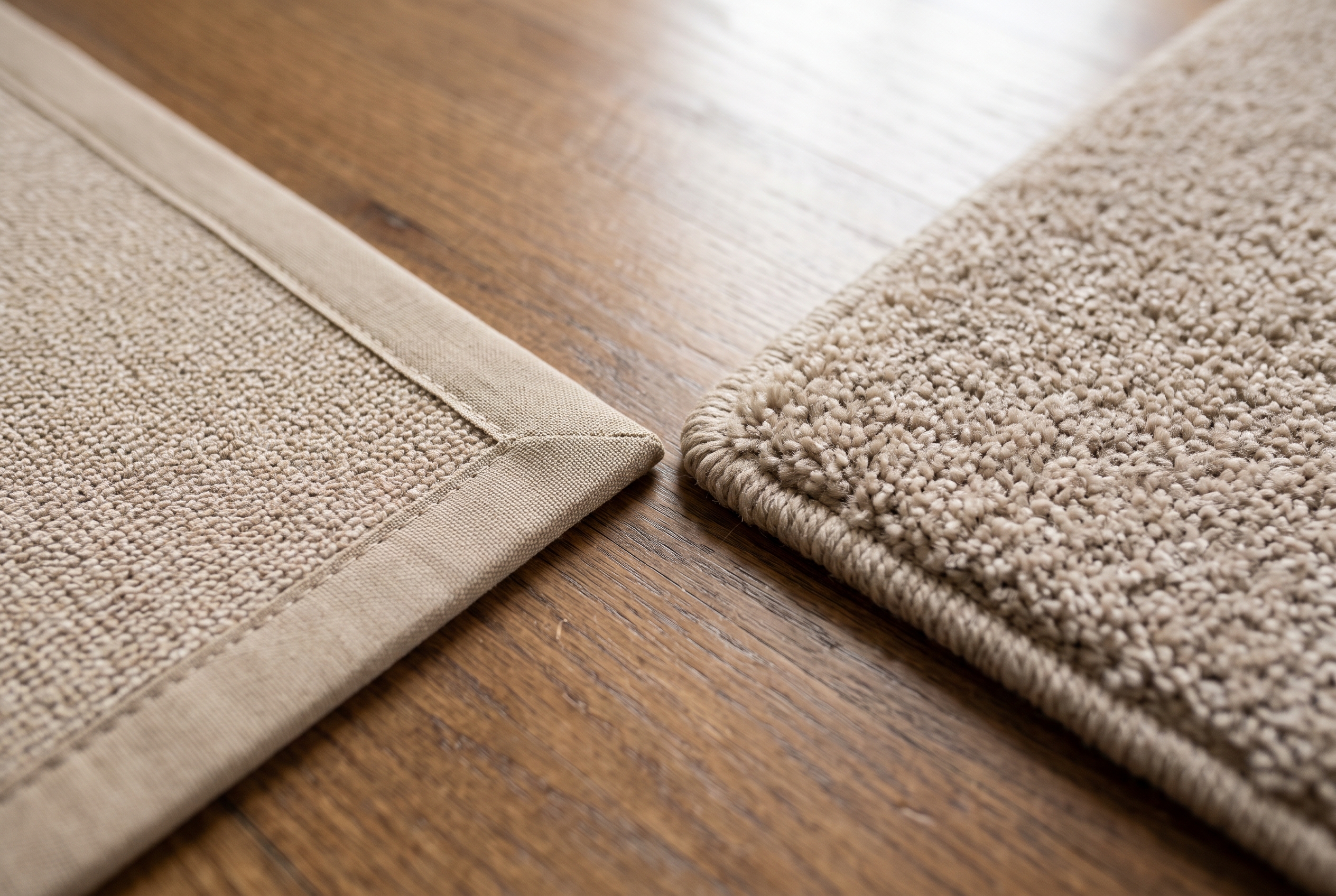
Binding and serging are the two usual ways to finish the cut edge of a piece of carpet so it stops fraying and looks like a rug. Binding folds a strip of fabric tape over the edge and sews it on, which leaves a flat, tidy band all the way around. Serging wraps the edge in yarn, stitch after stitch, so the edge comes out soft and rounded and usually blends into the carpet. Binding is the less expensive of the two. Serging is slower work and costs more per foot.
Neither one is right for every rug. Which suits yours depends on the carpet you're starting with, where the rug will lie, and whether you want the edge to frame the rug or disappear into it.
What Carpet Binding Is
Carpet comes off the roll with a raw, cut edge, and a cut edge doesn't stay neat for long. Bits of yarn work loose along it, and on carpet whose yarn is left in small loops, like Berber, one pulled loop can run down the row like a snag in a sweater. Binding closes the edge up. When we bind a rug, a binding machine folds a strip of tape over the cut and sews it through the carpet's backing, the woven base on the underside, so the edge ends in a band of fabric instead of loose yarn.
Most binding is a narrow band in a color matched to the carpet, so it reads as a clean finish rather than a feature. Go wider, or pick a contrasting color, and the binding becomes a border around the rug.
What Carpet Serging Is
Serging finishes the edge with yarn instead of tape. A serging machine winds a continuous yarn around and around the cut edge, with the wraps packed so close together that no backing shows between them. The yarn is chosen to match the carpet or one of its colors, so a serged edge looks like part of the rug rather than a frame around it.
Underfoot, a serged edge feels like a soft, rounded roll, where a bound edge feels like a flat band. Serging can be done by hand, and some fine rugs are still finished that way, but it's slow work, so nearly all serging today is done on a machine.
How Each Edge Looks, Feels and Wears
The look is the biggest difference. A bound edge is a defined line. In a matching color it's a quiet finish. In a contrasting tape it outlines the rug the way a mat outlines a picture. A serged edge has no line to speak of: the yarn carries the carpet's color right down to the floor, so the rug looks finished in its own material.
Both edges stop fraying, and both last for years on a rug that's used and looked after normally. They just wear in different places. On a bound rug, the tape takes the scuffing, at the corner the vacuum keeps hitting and along the stretch where a chair leg drags. On a serged rug, the yarn wraps take it, and where feet and the vacuum pass over the same stretch again and again, the yarn slowly thins until the backing starts to show. Ask around and you'll hear it argued both ways, that binding outlasts serging and that serging outlasts binding, and neither is wrong, because it depends on where the wear falls. For an edge that will be rubbed every day, under dining chairs, along a busy hall or in a doorway, we'd choose binding: the flat tape takes the rubbing, and a worn stretch is simple to rebind. Where the edge sees ordinary foot traffic, as most living room and bedroom rugs do, serging holds up just as well, so choose by the look.
| What you're weighing | Binding | Serging |
|---|---|---|
| Look | A flat band, matched to the rug or set against it as a border | A rounded yarn edge that blends into the carpet |
| Feel underfoot | Flat and firm | Soft and rounded |
| Where it wears | The tape, at corners and scuffed stretches | The yarn, thinning where feet and vacuums pass |
| Cost per foot | Lower | Higher |
What Binding and Serging Cost
Edges are priced by the foot, measured all the way around the rug, so the first number you need is that distance. Add up the four sides: a 5 x 8 rug has 26 feet of edge and a 9 x 12 has 42. For a round rug, multiply the width across by 3.14, which gives an 8-foot round a little over 25 feet.
RemodelCalculators, a cost site that pulls together the major national cost guides, puts binding a piece of carpet into a rug at about $1.50 to $4 a foot and serging at about $5 to $10 a foot. Those are national figures for the edge alone, not the carpet. At those rates, a 5 x 8 comes to roughly $40 to $105 bound or $130 to $260 serged, and a 9 x 12 to roughly $65 to $170 bound or $210 to $420 serged. A 2 1/2 x 10 hall runner has 25 feet of edge, which works out to roughly $40 to $100 bound or $125 to $250 serged.
Your own price can land anywhere in those ranges, or past them. Leather, linen and wide tapes cost more than plain polyester. Thick or plush carpet usually needs extra trimming along the edge before the tape will close over it, which adds labor. Curves are slower to sew than straight runs, hand serging costs far more than machine serging, and if the carpet has to be cut to size first, that's part of the price too.
Whether binding carpet costs less than buying a rug depends on where the carpet comes from. When it's carpet you already have, such as the leftover piece from your own installation, you're paying only for the edge, which is hard to beat. When you're buying new carpet to make the rug, add the carpet's price to the edge and compare that total with a ready-made rug in the same size. Ready-made rugs come with their edges already finished. A bound or serged rug makes the most sense when you need a size or shape the standard sizes miss, or a rug that matches carpet elsewhere in the house.
Which Edge Suits Your Carpet
Cut-pile carpet, the smooth, soft kind most bedrooms have, takes either edge well, so choose by the look you want.
Thick, plush or shag carpet is where serging shines. The yarn disappears into the deep surface and the edge looks natural. Binding still works, but the edge of a thick carpet usually has to be shaved down first, on a slant so it's thinnest at the very edge, so the tape can fold over cleanly. Even then, a narrow tape can look pinched on a deep carpet. On very thick carpet, we'd lean toward serging.
Loop carpet and Berber take one extra step. Before the edge is bound or serged, the cut is sealed with a line of seam sealer, a glue made for cut carpet, so a snagged loop can't run along the row. After that, either edge works. Binding gives the bumpy, looped surface a crisp border, and serging in a matching yarn lets the texture run right to the edge.
Patterned carpet gives you a design choice. A binding frames the pattern like a border. Serging in the pattern's main color lets the design carry all the way to the edge, as if the rug had been made to that size.
Wool carpet takes either edge. Serging in a matching yarn suits the soft look of a wool rug, and a cotton or leather binding suits a more tailored room.
Thin, low carpet is usually best bound. A flat band sits level with a thin rug, where a rounded serged edge can sit a little higher than the rug itself.
If you're still choosing the carpet for a rug, our carpet catalog lets you narrow it down by fiber and style first. Then pick the edge that suits the carpet you chose.
Which Edge Suits the Room
Dining rooms are hard on rug edges, because the chairs slide back over them at every meal. A flat bound edge takes the chair legs well. Better still is a rug big enough that the chairs stay on it when they're pulled out, which spares the edge altogether.
By an entry or a doorway, you want the lowest edge you can get, so the door clears it and nobody catches a toe on it. A thin carpet with a narrow binding is the safe choice there.
In a home with pets or small children, the edge gets tugged. A claw can hook a serged yarn, and a toddler can pick at a loose corner. Either edge holds up if small damage gets fixed while it's small: clip a loose yarn level with scissors as soon as you see it, never pull it, and keep the vacuum's spinning brush off the edge.
Living rooms and bedrooms are gentler on edges, so the look you want can decide.
Round, Oval and Custom Shapes
Serging follows a curve easily, because the yarn wraps the edge a stitch at a time. Binding tape has to be eased around a curve so it doesn't pull away from the edge, which is fine on a gentle oval and slower going on a tight circle. Both can finish a round rug well.
Some rugs have to fit around a hearth, a column or a bay window. For those, we cut the carpet to the shape you need and finish it the same way as a rectangle. We can also cut one large piece of carpet into several smaller rugs.
Edges for Hall Runners and Stair Runners
A hall runner is long and narrow, so it has a lot of edge for its size, and people walk along it rather than across it, with the vacuum running down both sides. A flat binding holds up well in a busy hall, and serging gives a softer look in a hall that sees lighter traffic.
On stairs, a runner's edges sit at the sides of every step, right where shoes land and the vacuum hits. Either edge works on a staircase as long as it's sewn tight and the runner is installed snug, because an edge that lifts on a stair is something to trip on. After that, the choice is the look: a crisp line of binding down each side of the stairs, or a softer serged edge that blends into the runner. Stair runners are usually cut from carpet to leave an even strip of wood showing on each side of the stairs, then bound or serged before they're installed. We design and install custom stair runners, and we bind or serge the carpet for them as well as for rugs.
Choosing the Binding Material, Width and Color
Polyester is the everyday binding tape and the least expensive. Cotton has a softer, more natural look. Leather makes a heavier, more formal border, and linen suits carpets with a natural, woven texture. Each of those costs more than polyester.
Width changes the effect more than people expect. A narrow tape finishes the edge without drawing the eye. A wide tape is a design choice: on a plain carpet, a broad band reads as a deliberate border, like the border woven into a traditional rug.
Color comes last. A tape matched to the carpet's strongest color makes the edge disappear. A contrasting tape outlines the rug. Contrast also shows dirt and wear sooner, a light tape on a dark rug most of all, so it works best on a rug that isn't in the main path through the room. Serging yarn is matched the same way, to the carpet or to one of its colors. We bind in a range of materials and colors, so you can match the edge to the rug or set it off.
Binding or Serging a Rug at Home
Sewn binding and serging are machine work: a binding machine folds and stitches the tape, and a serging machine wraps the yarn. At home, the option is glue-on binding tape, sold by the foot or the roll, some styled like a plain binding and some made to look serged. It goes on with a hot glue gun.
- Trim the edges straight and cut off any loose strings.
- On loop carpet, run a line of carpet seam sealer along the cut edge and let it dry, so loops can't run.
- Start the tape in the middle of one side, not at a corner.
- Most glue-on tape has a rounded edge that shows and a flat strip that glues to the back of the carpet. At each corner, snip into the flat strip, stopping short of the rounded edge, so the tape bends around, and keep the overlap tidy on the back.
- Run a thin line of hot glue between the tape and the carpet a short stretch at a time, and hold each stretch until the glue sets.
A glued edge is a quick fix for a doormat, a leftover piece in a closet or a rug in a room that gets light use. For a rug that's walked on, vacuumed and dragged under chairs every day, a sewn edge is the one we'd choose.
When a Rug Edge Is Fraying or Coming Loose
What to do depends on what you're looking at.
- Binding that's lifting where the stitches let go usually has plenty of life left in the tape. Resewing that stretch puts it right.
- Tape that's worn through, often at a corner or along the side that takes the traffic, has done its job. That side, or the whole rug, gets new binding.
- A serged edge with thin spots where the backing shows gets serged again. The worn edge has to be cleaned up first, because serging over a ragged edge can tear it further.
- Loops pulling out along the edge of loop carpet get clipped level with the surface, then the edge is sealed and finished again.
Until it's fixed, clip any loose yarn level with scissors instead of pulling it, keep the vacuum's spinning brush off that stretch, and turn the rug so the damaged side is out of the traffic.
A new edge only works if the carpet behind it is sound. If the backing has gone dry, cracked or crumbly, a new edge has nothing to hold on to, and the rug has reached the end of its life. Antique and hand-knotted rugs are a different matter. Their edges are woven into the rug rather than added afterward, and repairing them is work for a rug restorer.
A rug that was cut from carpet, rather than woven as a rug, can simply get a fresh edge if the carpet is sound, and we bind and serge used carpet as well as new.
Caring for a Bound or Serged Edge
Vacuum rugs with the spinning brush switched off or raised, on suction only, and go easy along the edges. A spinning brush grabs at serging yarn and scuffs binding tape, and over the years that's most of the wear an edge sees.
Blot spills on the edge rather than scrubbing them, and let the rug dry flat. Turn the rug every few months so the same side isn't always the one by the door or under the chairs. A rug pad underneath helps too, because it keeps the edge lying flat where it can't catch a foot or the vacuum.
Bound and Serged Rugs and Runners in Murfreesboro and Nolensville
At Faith and Grace Flooring, we bind and serge custom area rugs, hall rugs and stair runners. You can choose the carpet from our selection or bring carpet you already own, new or used, and we cut it to the size and shape you need. If you'd rather have a rug that arrives finished, our area rug catalog has ready-made rugs in standard sizes.
You'll find us at 902 Dashiel St in Murfreesboro and 7305 Nolensville Rd in Nolensville. If you're bringing your own carpet, bring the measurements of the space with it, and a photo of the floor the rug will sit on.
Getting Your Rug Edged
Whether you've settled on binding or serging or you're still deciding between them, request a free estimate and we'll price the rug, the runner or the leftover carpet you've been meaning to do something with.


