

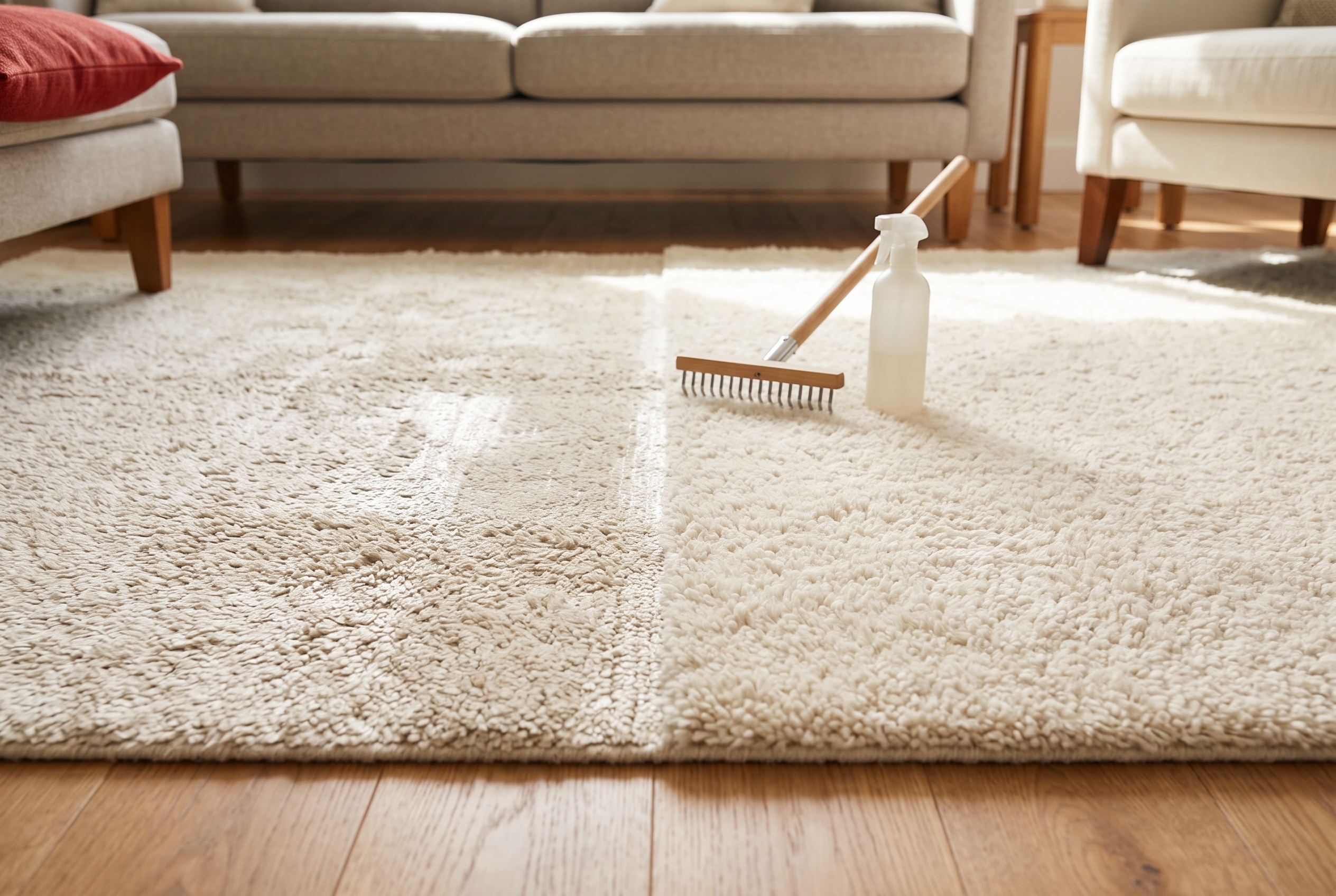
The path to the sofa has gone flat and shiny, or the dog's favorite corner feels like felt. Most matted rugs come back if you do three things in order. Get the grit and old soap out of the pile, dampen the flattened fibers, and brush them upright while they dry.
Whether that works depends on the fiber. Crushed pile stands back up once it gets wet. Pile that has tangled into felt, melted under heat or worn away does not, and a few popular tricks cause that kind of damage on the wrong rug. If your rug feels stiff or crunchy rather than flat, leftover soap is the usual cause, and more water, not more soap, softens it.
Wool rugs come back best. Wool fibers have a natural crimp that lets them compress and spring back. A light mist or a steamer held over the pile, followed by gentle brushing, usually lifts them. Avoid hot water and hard scrubbing, which can turn wool into felt.
Nylon rugs spring back almost as well. A damp mist, a stiff brush and a slow vacuum lift most crushed paths. Never let an iron touch the pile.
Polyester and polypropylene rugs, the fibers in most machine-made rugs, come back partway. A dense, low pile responds to rinsing, misting and a rug rake, while a plush or shaggy one often stays flat where people walk. Keep irons and hot hair dryers away, because polypropylene starts to melt at about 320 F and an iron on its cotton setting can reach 392 F. A hair dryer on its cool setting is fine.
Viscose rugs, also sold as art silk or bamboo silk, rarely recover once crushed. Water weakens the fiber, so brush it dry in the direction of the pile and leave washing to a professional.
Flatwoven cotton, jute and sisal rugs have no upright pile to crush, so they seldom mat. Shake and vacuum them, and keep water off jute and sisal.
Shag, sheepskin and faux fur rugs need detangling more than lifting. Shake them, pull the clumps apart by hand and comb them out. Use a wire pet brush on sheepskin and no heat at all on faux fur.
Wool and nylon recover well, the common synthetics partly and viscose rarely, and each fiber has one treatment it cannot take.
| Rug fiber | What works | What to avoid |
|---|---|---|
| Wool | Mist or steam, soft brush | Hot water, scrubbing |
| Nylon | Mist, stiff brush, steamer | An iron on the pile |
| Polyester, polypropylene | Rinse, mist, rug rake | Irons, hot hair dryers |
| Viscose, art silk | Dry soft brush, pro cleaning | Water, steam, rubbing |
| Cotton, jute, sisal | Shake, vacuum, trim loose loops | Soaking; steam on jute |
| Shag | Shake, detangle by hand, rake | Beater bar on the pile |
| Sheepskin | Wire brush, dry | Heat, hot water |
| Faux fur | Comb, cold gentle wash | Any heat, fabric softener |
The page runs in this order, so you know how far to scroll. First comes how to tell what is wrong with your rug, then the step-by-step fix, then what heat, steam and water do to each fiber. Next are furniture dents, traffic paths and pet spots, shag, sheepskin and faux fur, and rugs that are stiff after washing or a carpet cleaner. The page ends with tools, rugs that can't be saved, keeping a rug from matting, choosing one that won't, and common questions.
Why does my rug look matted?
Your rug looks matted because one of seven things has happened to its pile, the upright yarn on the face. The pile may be crushed flat, tangled or felted into clumps, dented by furniture, stiff with soap, melted at the tips or worn down to the backing. Or you may be seeing shading, a trick of the light that is not damage at all.
Two quick tests sort out most rugs. First, wet a fingertip, press it into the flat spot and rub a small circle. Pile that lifts and separates was only crushed, and the steps on this page will bring it back. Pile that stays stuck together has tangled or felted, which is harder to fix and sometimes permanent.
For the second test, walk to the far side of the room and look again. If the dark and light patches swap places, you are seeing shading or pooling. The IICRC, the body that certifies cleaning and restoration technicians, calls shading a normal feature of smooth cut pile such as velvet and plush, not a defect.
Shading comes from tufts leaning in different directions and catching the light differently. When footprints or vacuum strokes caused it, brushing in the pile's normal direction puts it right, according to the Carpet Institute of Australia, the industry body there. Patches that appear on their own and won't brush out are a change in pile direction, not color. The institute says they don't shorten a rug's life.
Worn pile is a different matter. The IICRC treats wear as lost fiber, and it says flattened or tangled yarn does not count as wear under carpet makers' guidelines. To check, part the pile in the traffic path and then at an edge nobody walks on. If the path shows far more backing, fiber is gone.
Hard, glassy tips on a synthetic rug mean heat reached it. An iron, a hair dryer held too close, a space heater or friction can all do it. Melted fiber can't be brushed back up. Mohawk's advice for scorched carpet fibers is to snip off the damaged tips with curved scissors.
Pile that feels stiff, sticky or crunchy, or that gets dirty again within weeks of a cleaning, is usually full of residue. Milliken, a carpet and rug maker, warns that too much detergent leaves a film on the fibers that attracts dirt fast. That calls for rinsing, not brushing.
Most matting is crushed pile that moisture and brushing can fix, and felt, melted tips and worn fiber are the exceptions.
| What you see | What it is | What helps |
|---|---|---|
| Flat pile that lifts when damp | Crushed pile | Moisture, brushing, fast drying |
| Clumps that stay stuck together | Tangled or felted fibers | Hand detangling; felt is permanent |
| Round or square pits | Furniture dents | Ice melt or steam, then brushing |
| Patches that swap light and dark | Shading or pooling | Brush with the pile; no damage |
| Stiff, crunchy, quick to resoil | Soap or cleaner residue | Rinse with clear water, dry fast |
| Hard, glassy tips | Melted synthetic fiber | Trim; cannot be lifted |
| Backing showing in the path | Worn pile, fiber lost | Replace or move the rug |
Read the label for the fiber
The rug's label names its fiber, and every fix on this page depends on it. Federal rules require rugs, carpets and mats sold in the U.S. to carry a fiber content label. Because rug backings are exempt, the fiber listed is the yarn on top. Look for a sewn-in tag on the underside near a corner.
Viscose may be labeled rayon, because the FTC accepts viscose as the name for the main form of rayon. The agency also says textiles sold as bamboo are almost always rayon, so a bamboo silk rug is a viscose rug. If the tag is gone, a strong silky sheen points to viscose or polyester, and the seller can usually look up the fiber from the rug's name.
Look at the back to see how it was made
The back of a rug shows how it was made, and the construction decides how much water and brushing the rug can take. Fold a corner over and look for one of these four backs.
- A canvas cloth glued over the whole back means a tufted rug. Its yarn was punched through a base fabric and is held in place by latex, a rubbery glue, with the cloth glued on top. Go light on water, and treat tufts that pull out easily as a warning.
- Rows of small knots, with the pattern showing clearly on the back, mean a hand-knotted rug, where each knot was tied by hand. Jaipur Living, a rug maker, says these can last for generations. Leave deep washing to a professional.
- A back that looks like a neat, tight grid of the front's pattern, often woven with jute or cotton, usually means a power-loomed rug made on a machine loom. Most are polyester or polypropylene, and the jute or cotton in the back is what stains if it stays wet.
- A back that looks the same as the front means a flatweave, such as a dhurrie or kilim, which has no pile to crush.
Wall-to-wall carpet that has gone flat needs a different approach, since you can't flip it, wash it or carry it outside. Our guide to why carpet looks matted and how to revive it covers installed carpet.
How to fix a matted rug, step by step
This routine fixes most matted rugs with an hour or two of work and a day of drying. It clears out what is weighing the pile down, relaxes the flattened fibers with moisture and sets them upright as they dry. Test any water or steam on a hidden corner first, and match step 4 to your rug's fiber.
- Check the label and the back. The fiber and the construction tell you how much water and heat the rug can take.
- Shake or beat the rug, then vacuum both sides. Grit packed into the base of the pile holds it down and grinds it like sandpaper. Shake small rugs outside, and hang larger ones over a clothesline and beat them, as the Carpet and Rug Institute suggests. On wool, shag and viscose, turn off the beater bar, the spinning brush in the vacuum head.
- Rinse out residue if the pile feels stiff or sticky. Blot the flat area with a cloth dampened in clear water, a small section at a time. Then blot again with a dry towel.
- Dampen the flattened pile. Mist it with plain water until it feels damp, not wet. Use ice cubes for deep dents, or hold a garment steamer a few inches over wool and nylon. Skip this step on viscose and jute.
- Groom the pile upright while it is damp. Work tangles apart with your fingers, then use a stiff brush or rug rake in short, gentle strokes that lift rather than scrub. Finish each patch with strokes in the direction the pile naturally leans.
- Dry it fast. Aim a fan at the damp area, and run the air conditioning or a dehumidifier. Keep the rug off a wood floor until it is dry right through.
- Brush or vacuum once more when it is dry. That last pass lifts whatever settled as it dried.
No rug rake? Your fingers, a stiff scrub brush, or the edge of a spoon or a coin will lift a small patch just as well.
Protect the floor under the rug
Water from melting ice or a steamer runs straight through most rugs and onto the floor under them. On hardwood or laminate, slide a folded towel and a plastic bag under the spot before you start, or lift the rug onto a table or chairs. Nourison, a rug maker, tells anyone cleaning a rug indoors to put a waterproof tarp underneath to protect the floor.
Never lay a damp rug back down on a wood floor. If a wet rug has already marked the finish, more drying won't fix it, and that is the time to call our hardwood refinishing service.
Drying a rug in a Middle Tennessee summer
Summer humidity is why a rug in Murfreesboro or Nolensville dries more slowly than the instructions suggest. NOAA's long-term averages for Nashville, the nearest long-running weather station, put morning humidity at 86 to 89 percent from June through September. It eases to about 55 percent by early afternoon. A rug set outside at breakfast sits in air that is close to saturated.
Dry it indoors with the air conditioning on, or outside on the afternoon of a dry, breezy day. Raise it so air reaches the back. The EPA's rule for anything wet indoors is to dry it within 24 to 48 hours to prevent mold, and to keep indoor humidity under 60 percent, ideally 30 to 50. If a valuable rug is soaked through and you can't get it dry in that window, the EPA suggests calling a specialist such as a rug cleaner.
Slow drying has a second cost. The IICRC warns that cotton and jute, the fibers in many rug backings, turn yellow or brown when they get wet and dry slowly. It advises leaving that stain to a professional. Give wool extra time as well, since Nourison notes that wool holds moisture without looking wet.
When to stop brushing
Stop brushing once two full rounds, each followed by complete drying, have made no difference. A badly matted traffic path often needs two or three rounds, and if the pile rises a little more each time, keep going. If it doesn't move at all, the fibers are felted, melted or worn. More steam will only stress them.
What heat, steam and water do to each rug fiber
Never press an iron onto a rug, use a hair dryer only on its cool setting over synthetics, and save steam for wool and nylon, held a few inches over the pile. Heat and moisture are what make crushed fibers stand up again. They are also what melts synthetics, felts wool and weakens viscose, so the right amount depends on the fiber.
Wool rugs
Wool recovers from crushing better than any other rug fiber. Each fiber has a natural crimp, a built-in wave that lets it compress and spring back. Nourison says dense wool is less likely to flatten for good than many synthetics. American Wool, the consumer site of the U.S. sheep industry, says a wool fiber can bend more than 20,000 times before it breaks.
That makes wool the rug where steam works best. Hold a garment steamer a few inches over the flat spot. Or lay a damp towel over it and touch a steam iron set to wool to the towel for a few seconds, keeping the iron moving and off the pile. Then brush gently with the pile.
What wool can't take is hot water with hard rubbing. Woolmark, the wool industry's research body, explains that wool fibers are covered in tiny scales that lock together when wet wool is agitated. A peer-reviewed review of wool shrinkage calls the result irreversible. That is felting, and it is how a crushed wool rug becomes a truly matted one.
Nourison leaves full steam cleaning of wool rugs to specialists, since too much heat and moisture can damage wool. At home, use steam in short bursts on the flat spots only.
Nylon rugs
Nylon is one of the most resilient synthetic fibers, which is why it dominates wall-to-wall carpet and turns up in custom rugs cut from carpet. The University of Georgia Extension lists it as strong and resilient, and a crushed nylon path usually lifts with a damp mist, a stiff brush and a slow vacuum.
A steamer held over the pile is fine on nylon. An iron is not, since nylon, like every synthetic, melts if it gets too hot.
Polypropylene and polyester rugs
Polypropylene, often labeled olefin, and polyester make up most machine-made rugs, and how well they recover depends on how the rug is built. A University of Florida extension fact sheet rates polypropylene's resilience as good only when high piles are avoided. It also notes that polypropylene tends to show traffic patterns. Nourison, which sells many polypropylene rugs, calls them resilient and crush resistant because of the way they are made.
The two views fit together. A dense, low polypropylene pile holds up well, while a plush or shaggy one flattens in the traffic path and stays flat. Polyester has improved a great deal since the early versions that matted and crushed, the Florida fact sheet says, but a soft, plush polyester pile still flattens where people walk.
Heat is the danger with both. Polypropylene does not melt below 320 F, according to the Polymer Science Learning Center at the University of Southern Mississippi. The international care-label standard lets an iron on its cotton setting reach 392 F. The University of Georgia Extension says never to iron olefin, and it lists polyester among the fibers that melt if too hot.
So use cool water, a rug rake and patience on these rugs. If you want steam, hold the steamer well over the pile, keep it moving and test a hidden corner first. Keep a hair dryer on its cool setting, and trim any tips that have already gone hard and glassy.
Viscose, art silk and bamboo silk rugs
Viscose, a plant-based fiber made to look like silk, is one of the rug fibers least likely to recover once it's crushed. Jaipur Living warns that heavy furniture can flatten viscose and suggests keeping viscose rugs out of busy rooms.
Water weakens it. The University of Georgia Extension lists rayon as weaker when wet. Nourison says moisture weakens viscose so that rubbing can break the fibers, and Jaipur Living adds that moisture and steam damage silk and viscose rugs over time. So skip the ice cubes and the steamer.
What you can do is brush it dry. After a spill, Nourison's advice is to blot, then comb the pile in its own direction with a soft brush. Expect it to look flatter and shinier until it dries and can be brushed again. Leave washing to a professional, because Nourison warns that the wrong chemicals can yellow viscose.
If you already scrubbed a spill, the rubbing probably crushed and frayed fibers that the water had weakened. That is why the spot looks darker or fuzzier than the rest. Let it dry, brush it gently with the pile, and check it from both sides of the room. If it looks different from every angle, the fibers are damaged, and a professional rug cleaner can tell you how much more can be done.
Cotton, jute and sisal rugs
Flatwoven cotton, jute and sisal rugs rarely mat, because they have no upright pile. Jaipur Living describes flatweaves as rugs made only of warp and weft, the lengthwise and crosswise threads of any woven cloth. What looks like matting on one is usually soil or a crease.
Small cotton flatweaves can often go in the washer if the label allows. Jute and sisal are the opposite. Nourison says never to steam clean or wet shampoo them, because plant fibers soak up liquid, shrink and pucker, and to dry any spill right away with a fan or hair dryer.
Loose loops that poke up from a jute or sisal rug, called sprouts, are normal. Jaipur Living says to trim them with scissors.
How to get furniture dents out of a rug
You moved the sofa and found four deep pits where its legs stood. Furniture dents in a rug are pile crushed under a heavy point. On wool and nylon, shallow dents often rise partway on their own within a day or two. Deep or old dents need moisture and brushing.
- On hardwood or laminate, put a folded towel and a plastic bag under the dent.
- Set an ice cube in each dent, or several along a long one, and let it melt slowly, overnight if you can.
- Blot up the leftover water with a towel.
- Lift the fibers with the edge of a spoon or a coin, then brush them upright.
- Dry the spot with a fan before the furniture goes back.
Skip the ice on viscose, and go easy on rugs with a cotton or jute backing, which can brown if they dry slowly. On wool or nylon, steam is quicker. Lay a damp towel over the dent and touch a steam iron to it for a few seconds at a time. Mohawk, a carpet maker, gives the same warning for dents in carpet and says to keep the iron off the pile.
To keep dents from coming back, stand heavy legs on wide furniture cups, which spread the weight over more pile. Shift the furniture an inch or two whenever you turn the rug.
Flattened traffic paths and pet spots
A flattened traffic path is crushed pile with grit worked into it, and a pet's favorite spot is crushed pile with hair and body oil. Both come back with the same routine. Vacuum thoroughly, brush the pile up, and turn the rug so the wear moves too.
Traffic paths
Vacuum the traffic path slowly from more than one direction. Then rake or brush it upright and finish with strokes that follow the pile. The Carpet Institute of Australia notes that regular vacuuming and periodic professional cleaning reduce how much pile flattens in normal use.
On soft, plush rugs, a path can show up as rows of tufts bent over across the direction of travel. The IICRC calls this corn rowing. It happens when pile is too soft and loosely packed to hold itself up, and raking across the path is the one thing that sometimes helps.
Then turn the rug so the path moves before it sets. Karastan and Nourison both suggest rotating rugs every six to 12 months. Jaipur Living suggests every three to four months for delicate silk and viscose.
Pet spots
Pet spots mat the way sofa-leg dents do, from steady weight in one place, plus hair and body oil that make fibers clump. Brush the spot and vacuum it more often, as the Carpet and Rug Institute recommends in homes with pets. If accidents are part of it, blot and rinse with cool water. The institute warns that steam sets both the stain and the smell of urine.
How to make a shaggy rug fluffy again
A shaggy rug goes flat because its long pile lies over and tangles, most of all where people walk and pets lie down. So shag needs detangling more than lifting. Shake it, work the clumps apart, clear the grit from the base and rake the pile back up.
- Shake a small shag rug hard outside. Jaipur Living recommends shaking smaller shags to loosen the dirt that builds up in high pile.
- Pull the clumps apart with your fingers, starting at the tips and working down, instead of tearing through them with a rake.
- Flip the rug face down on a hard floor and vacuum the back with the beater bar switched on. Nourison suggests this to knock buried grit out onto the floor. Vacuum up the grit, turn the rug over and give the pile a last pass with the beater bar off.
- Rake the pile upright with a shag rake or a wide-tooth comb, in short strokes, finishing in one direction.
For regular vacuuming, Jaipur Living suggests a hand-held or upholstery attachment on the face of a shag, since it won't grab long fibers the way a spinning brush does. If your shag is polyester or polypropylene, keep irons and hot air away from it. Wash one only if the label allows, rinse until no suds are left, and dry it flat and fast.
Shag in a main walkway will flatten again however often you rake it. Nourison describes its own long shag as a rug for moderate-traffic rooms, where comfort matters more than moving chairs. It suggests a professional cleaning every year or two for shag in a busy room.
How to fluff a sheepskin or faux fur rug
Sheepskin and faux fur rugs mat the way shag does, as long fibers tangle where people sit and step, but they need opposite care. A sheepskin rug is real wool on a leather hide. A faux fur rug is a synthetic pile that heat will ruin.
Sheepskin
A matted sheepskin rug comes back with dry brushing. Sheepskin makers recommend a medium-firm wire brush, the kind sold for dogs and often called a slicker brush. Work it through small sections, from the tips down toward the hide. After a wash, one New Zealand seller suggests brushing once while damp and again when dry.
Sheepskin makers disagree about washing. One Pennsylvania maker says a washing machine will destroy a sheepskin rug, while the New Zealand seller allows cool or lukewarm water up to 108 F with an enzyme-free wool wash. Follow the tag, and if it says nothing about washing, keep the rug out of the machine.
Both makers agree on drying: let the rug air-dry away from direct heat and sun. The New Zealand seller also rules out bleach and suggests stretching the skin back into shape while it is still damp. If the tag says dry clean only, believe it.
Faux fur
Faux fur is usually acrylic, modacrylic or polyester, and heat ruins it. The University of Georgia Extension notes that faux fur rugs made of modacrylic frizz when they meet heat from a hair dryer, a heater or even a hot light bulb. Never blow-dry or iron one.
Vacuum faux fur on the lowest suction-only setting, back as well as front, as Nourison advises. Wash small ones on a cold, delicate cycle without fabric softener or scent beads. Let it air dry, then comb the fibers apart with a wide-tooth comb or a slicker brush.
A faux fur rug that came out of a dryer crunchy or frizzy has melted at the tips, and that texture won't brush back. If it is only stiff after a cold wash, soap is the likely cause. Rinse it in clear water, let it dry, then comb it.
Why a rug is stiff or crunchy after washing
A rug that comes out of the wash or a shampoo stiff, crunchy or flat usually has soap left in it, or it was walked on before it dried. Milliken warns that too much detergent leaves a residue that attracts dirt quickly. The IICRC lists unrinsed soap, body oils and pile that never fully dried among the main causes of fast resoiling.
The fix is more water, not more soap. Rinse or blot the area with clear water until no suds appear. Pull out what you can with a wet-dry vacuum or towels, and dry it fast. Once it is completely dry, vacuum and brush it.
Next time, use the least detergent that does the job. The IICRC suggests avoiding any spot cleaner that claims no rinsing is needed.
Before you use a spot cleaner, try the IICRC's residue test. Let about half an ounce, mixed as directed, evaporate in a small glass. If it leaves a sticky film, that film will end up in your rug.
Machine-washable rugs have their own instructions, and they differ. The Carpet and Rug Institute's general guidance for a small washable rug is warm water between 90 and 105 degrees F, mild detergent and a tumble on the lowest heat. Nourison's washable rugs call for cold water and air drying. Follow your rug's tag, and shake or brush the pile while it is still slightly damp so it dries standing up.
Using a carpet cleaner on a rug
A home carpet cleaner or rental shampooer is fine on a polyester or polypropylene rug if you rinse with clear water and get the rug dry within a day. HomeAdvisor's cost guide says synthetic rugs take steam cleaning, the hot water extraction these machines do, without damage. The Carpet and Rug Institute's Seal of Approval tests extractors and cleaning solutions, so look for it on the machine and the soap.
Keep the machine off wool, viscose and jute. Nourison warns that water-based deep cleaning at home risks permanent damage to absorbent wool and jute, and viscose weakens when wet.
On any rug, don't scrub while you clean. The Carpet and Rug Institute warns that scrubbing a spot with a brush frays the pile and changes its texture. Gentle grooming once the rug is clean is a different thing.
The tools that lift rug pile
For most rugs, your fingers, a stiff brush and a rug rake do the lifting, and the vacuum's setting matters more than its brand. A rug rake, also sold as a carpet rake, is a wide rake with stiff plastic or rubber tines that reach the base of plush and shag pile.
| Tool | Use it on | Keep it off |
|---|---|---|
| Your fingers | Tangles, shag, faux fur | Nothing; start here |
| Soft brush | Viscose, wool, silky pile | Deep tangles |
| Stiff brush | Nylon, polyester, polypropylene paths | Viscose, sheepskin |
| Rug or carpet rake | Shag, plush, crushed paths | Loop pile, fringe, viscose |
| Wide-tooth comb | Shag, faux fur, fringe | Tight, low pile |
| Wire slicker brush | Sheepskin, faux fur | Cut-pile rugs |
| Garment steamer | Wool, nylon | Viscose, jute, faux fur |
| Vacuum on suction only | Wool, shag, loops, viscose | Nothing |
Rug makers such as Nourison and Jaipur Living tell you to vacuum with the beater bar off. A spinning brush can pull and snag yarns and catch long fibers, loops and fringe.
Milliken takes the opposite line for its dense commercial textiles and recommends a brush-roll upright to lift soil. The difference is construction. A brush roll helps a dense, tightly twisted synthetic pile and frays a wool, shag or viscose rug.
If your vacuum keeps pulling fibers out of a rug, the IICRC says the brush roll is set too low or is too stiff for that rug. When you buy a rake, match it to the pile, with long, widely spaced tines for shag and a short-bristled brush for low pile.
When a matted rug can't be saved
A matted rug can't be saved when its fibers have changed rather than just bent. Felted wool, melted synthetic tips, worn-away pile, heavily crushed viscose and a tufted rug whose latex has failed won't respond to anything you can do at home.
Felt and melted tips are permanent because wool's scales lock for good and fused plastic can only be trimmed. Worn pile shows as backing in the traffic path. Viscose that has been walked on for years rarely rises again, and Jaipur Living describes it as easily flattened by heavy furniture.
A failing tufted rug catches many people out. The Association of Rug Care Specialists, a trade group of professional rug cleaners, explains that tufted rugs hold their yarn with a layer of latex that starts breaking down as soon as it is applied. Over time the backing ripples, cheap latex can fail soon after purchase, and old latex crumbles into a fine, sandy powder under the rug. When tufts pull out easily or the back crumbles, the rug is at the end of its life, however fluffy the face looks.
When a professional rug cleaner is worth the cost
A professional rug cleaner can wash out soil and residue that home methods leave behind, which is often what brings a flat rug back. HomeAdvisor's national cost data, gathered from customers after completed jobs and updated in June 2026, put most rug cleaning at $100 to $350, or about $1 to $8 a square foot. It lists $1 to $4 a square foot for synthetics, $3 to $8 for wool and $5 to $8 for hand washing.
The same guide notes that large rugs and high-end hand-woven rugs usually cost more to replace than to clean, while old, heavily soiled or damaged rugs may not respond well to cleaning. Ask the cleaner what they can and can't fix before you hand the rug over.
How to keep a rug from matting again
A rug resists matting longest on a pad, vacuumed often and turned now and then. Nourison recommends a rug pad under every rug to extend its life. Karastan says a pad cuts the friction between rug and floor that wears it down.
Vacuum at least once a week, and twice a week where people walk most, as the Carpet and Rug Institute advises. Use suction only on wool, shag and viscose. Rotate the rug, cup the furniture legs, blot spills instead of scrubbing them, and stop grit at the door with mats and a shoes-off habit.
Keep indoor humidity between 30 and 50 percent, the EPA's ideal, so wool doesn't sit damp through a Tennessee summer. Plan a professional cleaning every 12 to 18 months for a living room rug, the interval Nourison suggests for wool.
Choosing a rug that won't mat
Choosing a rug that won't mat comes down to four things: the fiber, how densely the tufts are packed, how tightly the yarn is twisted and how tall the pile is. If the old rug is past saving, pick the new one for the spot it has to live in.
Fiber sets the ceiling. The University of Florida fact sheet rates wool's resilience excellent, nylon's very good and polypropylene's good only in low piles. Our comparison of triexta, nylon and polyester carpet fibers explains how each synthetic recovers, which matters if you're having a rug cut from carpet.
Density and twist decide how close a rug gets to that ceiling. The Carpet and Rug Institute says cut pile holds up through fiber, tuft density and yarn twist, and that tightly twisted yarn holds its shape longer. The Florida fact sheet adds that soft, loosely twisted yarn soon goes fuzzy and matted.
Test a rug in the store by bending a corner back over your finger. If the backing shows easily between the tufts, the pile is loosely packed and will flatten sooner.
Pile height and construction do the rest. Nourison calls a quarter inch or less low pile and anything over half an inch high pile, and low, dense pile is what survives a walkway. Loop pile resists crushing, as our guide to carpet pile types explains, though big loops can snag. Hand-knotted rugs can last for generations, while a tufted rug lasts only as long as its latex.
Keep viscose for bedrooms and formal rooms, or choose a blend. "Combining viscose with wool makes rugs more durable, so these collections are a little more versatile in where they can be placed," says Ali Veremakis, a stylist at Jaipur Living.
For a hallway, an entry or the path to the sofa, these rugs hold up well:
- Dense, low-pile wool
- Hand-knotted wool
- Wool or cotton flatweaves
- A tight, low loop
- Dense, tightly twisted nylon or triexta cut pile
These mat fastest in the same spots:
- Polyester or polypropylene shag
- Soft plush with loosely twisted yarn
- 100 percent viscose
- Loosely tufted rugs with a thin latex back
Area rugs and custom rugs from our Murfreesboro and Nolensville showrooms
Faith and Grace Flooring, with showrooms in Murfreesboro and Nolensville, sells ready-made area rugs from makers including Nourison, Milliken, Jaipur Living, Stanton and Harounian Rugs. The area rug catalog can be filtered by fiber and pile height. That makes it easy to shortlist low, dense wool or tight polypropylene for a busy room before you visit.
Sometimes no ready-made rug fits the spot or stands up to it. For those spots, we cut carpet from our selection to your exact size and bind or serge the edges into a custom area rug, hall rug or stair runner. You can pick a dense, tightly twisted carpet from our carpet catalog for the hallway or entry where store-bought rugs keep matting. The price depends on the carpet you choose, the size and the edge finish.
Questions people ask about matted rugs
Can you put a rug in the dryer to fluff it?
It depends on the rug, and only a small rug whose tag says machine washable should go in, on low heat or none. The Carpet and Rug Institute suggests tumbling a small washable rug on the lowest heat setting, while Nourison's washable rugs call for air drying. Keep wool, viscose, jute, sheepskin and faux fur out of the dryer. Heat and tumbling can felt wool, frizz faux fur and damage a sheepskin's leather.
Does fabric softener or vinegar make a rug soft again?
No for fabric softener, which can make things worse, and vinegar helps clean but doesn't soften. Nourison says to leave fabric softener out when washing faux fur rugs, and both Milliken and the IICRC warn that product left in the pile attracts dirt. Jaipur Living includes equal parts white vinegar and water in the mild soap mix it suggests for wool and synthetic rugs. Use vinegar as a cleaner, then rinse with clear water.
Why does my new rug look flat or creased?
A new rug looks flat or creased because it was rolled or folded for shipping, and it usually relaxes within a few days, according to Nourison. To speed it up, weight curled edges with heavy books overnight or roll the rug the opposite way. A stubborn crease can be steamed through a damp towel with the iron kept moving, after you test a hidden spot. A rug pad helps keep creases from coming back.
Why is my wool rug shedding, and is that matting?
Shedding is normal in a new wool rug and has nothing to do with matting. The IICRC says new carpet can shed for up to two years, longer with wool, as short, loose fibers work their way out. Nourison notes that hand-tufted wool rugs shed the most and hand-knotted ones much less. Vacuum without the beater bar, and snip any tuft that sticks up out of the pile rather than pulling it, as Mohawk advises.
How do you fix tangled rug fringe?
Comb tangled fringe out when it is dry, working from the tips toward the rug with a wide-tooth comb. To keep it from tangling again, vacuum from the center of the rug toward the fringe with gentle suction, as the Carpet and Rug Institute suggests. Lift the edge to vacuum under the fringe rather than running the vacuum over it. Nourison adds that a brush cleans fringe after vacuuming, and that spills on it come out with mild detergent and warm water.
Why is my stair runner matted at the front of each step?
The front edge of each step, called the nose, takes every footstep while the runner is stretched over a curve, so it crushes years before the rest. Our article on what makes stair carpet safe and long-lasting explains why a low, dense pile holds up there. If a runner is worn through at the nose rather than flattened, the fix is a new runner cut from carpet to your stair width, and we make custom stair runners for that.
How long should a rug last before you replace it?
A quality wool rug can last 20 years or more with proper care, Nourison says, and a hand-knotted one much longer, while a tufted rug lasts as long as its latex holds. Replace a rug when fiber is visibly worn away, the back crumbles or sheds powder, tufts pull out easily, or matting comes back within weeks despite a pad, regular vacuuming and rotation.
When it is time for a new rug, bring the measurements and a photo of the spot to our Murfreesboro showroom or Nolensville showroom. Bend the samples back over your finger and choose a pile that will stand up to the traffic. If you want a hallway, entry or staircase measured for a rug or runner made to fit, request a free in-home estimate.


